Nov 13, 2025
What Is Medical Affairs and Why Does It Matters in Pharma
Unsure what is medical affairs? This guide explains its critical role in pharma, from KOL engagement to shaping healthcare strategy with real-world data.
Think of a life sciences company as having three main engines. You have the Research & Development (R&D) team, the brilliant minds discovering new treatments. Then you have the Commercial team, the sales and marketing experts who bring those treatments to the market. But who connects them? Who ensures the pure science from the lab is understood and applied correctly in the real world?
That’s where Medical Affairs comes in.
What Is Medical Affairs in Simple Terms

At its heart, Medical Affairs is the scientific and educational pillar of a pharmaceutical or biotech company. It operates as a non-promotional bridge, connecting the company's deep scientific knowledge with the physicians, researchers, and patients who need it most.
Their primary mission isn't to sell a product but to build trust and foster an open, scientific dialogue. Unlike their commercial counterparts, Medical Affairs professionals aren't measured by sales quotas. Their currency is clinical data and credibility, ensuring that healthcare providers have the precise information needed to use a product safely and effectively.
To better understand these distinct roles, it helps to see how their core functions compare.
Medical Affairs vs Commercial vs R&D Core Functions
Pillar | Primary Objective | Key Activities | Main Audience |
|---|---|---|---|
R&D | Discover and develop new therapies and generate preclinical/clinical data. | Lab research, clinical trial design and execution, drug discovery. | Regulatory bodies, internal science teams. |
Medical Affairs | Communicate scientific data accurately and gather clinical insights. | KOL engagement, evidence generation, scientific publications, medical education. | Healthcare Providers (HCPs), Key Opinion Leaders (KOLs), Payers. |
Commercial | Drive product adoption and achieve sales targets through branded promotion. | Marketing campaigns, sales calls, advertising, promotional events. | Prescribing HCPs, hospital administrators, pharmacists. |
This table shows how Medical Affairs occupies a unique middle ground, acting as a critical translator between the lab and the clinic.
The Bridge Between Science and Practice
The people driving Medical Affairs are typically experts with advanced degrees—think PhDs, PharmDs, or MDs. They engage with top physicians and researchers in peer-to-peer conversations, not sales pitches. They don't carry a sales bag; they carry a deep understanding of clinical data.
A day in the life might involve:
Meeting with a leading cardiologist to discuss the nuanced results of a recent clinical trial, such as unexpected benefits observed in a patient subgroup with specific comorbidities.
Answering a doctor's unsolicited, complex question about using a drug in a specific patient group that isn't detailed on the official label, like its use in a pediatric population.
Presenting new research findings at a major medical conference, fielding questions from fellow experts.
Medical Affairs acts as the connective tissue across R&D, commercial, regulatory, and market access functions. By aligning scientific and strategic objectives, this team enables informed decision-making at every stage of a product's lifecycle.
More Than Just a Support Function
Years ago, Medical Affairs might have been seen as just a support group. That view is long outdated. Today, it’s a strategic powerhouse that plays a crucial role in shaping a company's direction.
This team is on the front lines, gathering invaluable insights—often called the "voice of the customer"—directly from the medical community. This feedback is gold. It’s channeled back to R&D to guide future research, refine clinical trial designs, and pinpoint unmet patient needs.
This two-way street is what makes the function so vital. It ensures a company’s science stays grounded in the realities of clinical practice, which is absolutely essential for improving patient outcomes and achieving long-term success.
The Evolution from Support Team to Strategic Pillar

It’s hard to imagine now, but the Medical Affairs department we know today—a respected, independent strategic pillar—is a fairly new arrival. If you rewind the clock, you’d find these teams operating almost exclusively in a support role, usually tucked away under the commercial (sales and marketing) department. Their job was mostly reactive, serving up scientific backup for promotional campaigns and fielding clinical questions as they came in.
That old model, however, was fraught with problems. The line between a non-promotional scientific discussion and a branded sales pitch could get dangerously blurry, creating massive regulatory and reputational risks. The industry desperately needed a clear separation—a "firewall" to guarantee that conversations about science stayed purely scientific.
This need for separation didn't stay a recommendation for long. As regulators tightened their grip, it became a mandate. Landmark U.S. laws, including updates to the Anti-Kickback Statute and the arrival of the Physician Payments Sunshine Act in 2010, completely changed the game. These regulations demanded strict transparency and a firm division between promotional efforts and scientific exchange.
The Catalysts for Change
This regulatory pressure was the main force that pushed Medical Affairs out from under the commercial umbrella and established it as its own strategic department. By the early 2000s, the modern, independent Medical Affairs function started taking root across the industry. This wasn't just a tweak to the org chart; it represented a fundamental shift in philosophy.
And that evolution has only accelerated. According to a 2021 McKinsey report, as Medical Affairs grew into a strategic leader, its headcount across major pharma companies was projected to increase significantly. The report notes that interactions with Medical Affairs are rated as 25% more impactful by healthcare providers than those with sales reps. You can dig into a great analysis of this shift from the Medical Affairs Professional Society.
Learning from a High-Profile Case
Nothing teaches a lesson quite like a real-world disaster, and the pharmaceutical industry had a big one. A defining moment came in 2004 with the withdrawal of the pain medication Vioxx (rofecoxib) after it was linked to an increased risk of heart attack and stroke.
The Vioxx controversy threw a harsh spotlight on major problems in how clinical trial data was being shared with doctors and researchers. It was a painful illustration of what can happen when promotional goals are allowed to color scientific dialogue. The fallout served as a wake-up call that putting sales ahead of scientific integrity can destroy patient safety, public trust, and a company's future.
The Vioxx case became a catalyst, forcing companies to fundamentally rethink how they managed the flow of scientific information. It became clear that an independent, scientifically-driven function was not just a good idea—it was a necessity for sustainable and ethical operation.
The Rise of a Strategic Powerhouse
Today, the answer to "what is medical affairs" is completely different than it was two decades ago. The modern department is no longer a reactive service desk; it's a proactive, strategic partner with a seat at the executive table. Its independence is its greatest asset, allowing it to be the credible and authentic scientific voice of the organization.
This new identity involves:
Driving Strategy: Medical Affairs teams are on the front lines, gathering critical real-world insights from physicians that directly shape R&D pipelines, clinical trial designs, and even commercial approaches.
Building Trust: Through peer-to-peer scientific discussions, they forge genuine, non-promotional relationships with Key Opinion Leaders (KOLs) and the wider medical community.
Ensuring Compliance: They act as the guardians of that ethical firewall, making sure every communication and activity meets strict legal and regulatory standards.
This journey marks a complete transformation from a tactical support crew to a core strategic function. By championing evidence-based communication and building a foundation of trust, Medical Affairs now plays an essential role in navigating the complexities of modern healthcare to ultimately improve patient outcomes.
The Core Functions of a Modern Medical Affairs Team
So, we know Medical Affairs has become a strategic powerhouse in life sciences, but what does the team actually do day-to-day? It’s a dynamic role, but the work boils down to five core functions that serve as the scientific conscience of the company.
These responsibilities ensure a product’s entire journey—from the earliest clinical trials to its use in the real world—is guided by sound science.
It’s best to think of these functions as a continuous cycle. Good scientific communication opens doors for expert engagement, which then uncovers the need for new clinical evidence. This simple diagram shows how these primary activities feed into one another.
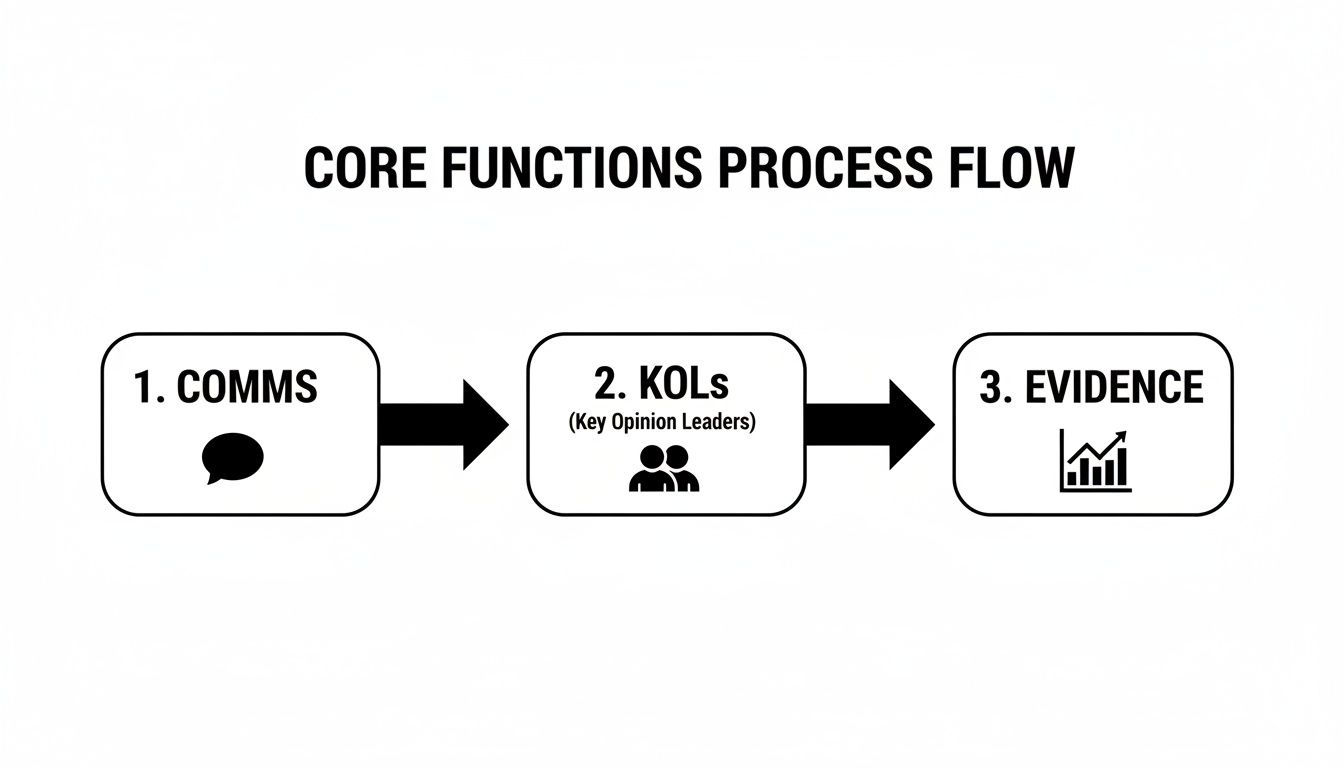
As you can see, clear communication sparks relationships with experts. Their insights, in turn, point the way toward new data, creating a powerful feedback loop that drives value.
1. Scientific Communications
This is perhaps the most visible job of Medical Affairs. At its heart, this function is about scientific storytelling. The team translates complex clinical trial data into clear, accurate, and non-promotional information for doctors and the broader medical community.
Their key activities include:
Publication Planning: Creating a strategic roadmap for publishing clinical trial results in respected, peer-reviewed journals like The Lancet or NEJM.
Conference Presentations: Developing the abstracts, posters, and oral presentations you see at major medical congresses, such as the American Society of Clinical Oncology (ASCO) annual meeting.
Medical Information: Acting as the go-to resource for healthcare providers (HCPs) who have unsolicited, often tricky, questions about a product's use, safety, or mechanism.
This isn't a minor role. In today's pharmaceutical landscape, Medical Affairs teams are a primary source of scientific information for HCPs. Field-based teams like Medical Science Liaisons (MSLs), for example, conduct millions of interactions annually with healthcare professionals. You can learn more about how Medical Affairs is guiding pharma's scientific engagement.
2. Key Opinion Leader Engagement
Medical Affairs owns the relationship with Key Opinion Leaders (KOLs)—the most influential and respected experts in any given therapeutic area. These aren't one-off, transactional conversations. They are true scientific partnerships built over the long term on a foundation of mutual respect.
This work is primarily done by a field-based team of Medical Science Liaisons (MSLs). An MSL, who almost always holds an advanced degree (like a PharmD, PhD, or MD), meets with KOLs for peer-to-peer scientific discussions to:
Share and get feedback on new clinical data before it's published.
Gather firsthand insights about unmet patient needs and gaps in treatment.
Identify potential investigators who could run future clinical trials.
Organize and run advisory boards to gather structured expert feedback on a product’s development plan.
A great MSL doesn’t just talk; they listen. The insights they bring back from the field are gold—they inform everything from R&D strategy to the very design of the next clinical trial.
3. Evidence Generation
The data from the initial clinical trials needed for drug approval is really just the beginning of the story. Once a product is out in the real world, a whole new set of questions pops up. How does it perform in a diverse patient population? What are the long-term effects? How does it stack up against other treatments?
Medical Affairs is in charge of finding the answers. This is where evidence generation comes in.
This function includes a few different approaches:
Phase IV Studies: These are studies designed and run after a product is approved to gather more data on long-term safety and effectiveness in a broader population.
Real-World Evidence (RWE): This involves analyzing data from sources like electronic health records, insurance claims, and patient registries to see how a product really performs in day-to-day clinical practice, outside the controlled environment of a trial. A practical example is analyzing a large claims database to compare rehospitalization rates between patients on a new drug versus an older one.
Investigator-Sponsored Trials (ISTs): Medical Affairs also supports research initiated by independent investigators who have their own questions about a company's product and want to study it.
4. Market Access Support
Getting a drug approved by regulators like the FDA is one giant hurdle. But getting it covered by insurance companies and government payers is a completely different, and equally challenging, one. Payers need to see evidence that a new treatment isn't just effective, but also provides good value for its cost.
Medical Affairs plays a crucial role here by helping build the "value story" for a product. This story is backed by solid scientific and economic data. Often, this work is led by a specialized group within Medical Affairs known as Health Economics and Outcomes Research (HEOR). For example, an HEOR team might develop a budget impact model that shows a hospital how adopting a new antibiotic could reduce overall costs by shortening patient stays and preventing costly complications, justifying a higher upfront price.
5. Compliance and Governance
Finally, and most importantly, Medical Affairs acts as the guardian of the company's scientific and ethical integrity. Every single activity, from an MSL's conversation with a doctor to a poster presented at a conference, is governed by a complex web of laws and industry codes.
This team ensures the strict "firewall" between non-promotional scientific exchange and commercial sales activities is never breached. This is fundamental to protecting the company, healthcare providers, and—above all—the patients who depend on these medicines.
How Medical Affairs Drives Value Across the Entire Company
It’s a common misconception to see Medical Affairs as just a scientific support function. In reality, it’s the connective tissue of a life sciences company, a central hub that creates value for nearly every other department. While its work is grounded in science and education, the insights and credibility it builds send ripples across the organization, directly benefiting R&D, commercial, and market access teams.
Think of Medical Affairs as the company's eyes and ears on the ground in the clinical world. Through peer-to-peer scientific conversations, they get the unfiltered truth from physicians about emerging treatment trends, unmet patient needs, and the real-world challenges of practicing medicine. This intelligence isn't just interesting—it's a critical asset that gets fed back into the organization to drive strategy.
Fueling Smarter R&D and Clinical Trials
The insights gathered by Medical Affairs are a goldmine for the Research & Development team. R&D can sometimes feel like it's operating in a bubble, but Medical Affairs is the team that brings crucial, real-world context straight from the clinic into the lab.
For instance, a Medical Science Liaison (MSL) might hear from several leading oncologists that a specific patient subgroup is struggling with existing therapies. That's not just a casual observation; it's a powerful signal of an unmet need. This feedback can directly shape the design of a future clinical trial, ensuring it answers questions that actually matter to doctors and their patients.
This close partnership leads to tangible results:
More Relevant Trial Designs: Protocols are built around real-world clinical problems, which not only helps with patient recruitment but also ensures the trial's endpoints are meaningful.
Finding New Opportunities: Conversations in the field can uncover potential new uses (or indications) for an existing drug, breathing new life into a product.
Faster, More Focused Research: When research is aligned with clinical practice from day one, it prevents costly mistakes and gets truly necessary therapies to patients faster.
Empowering Market Access and Proving a Drug's Worth
Getting a drug approved by the FDA is a huge milestone, but it's only the first step. The next, and arguably tougher, challenge is convincing payers—the insurance companies and health systems—that a new drug is worth its cost. This is where the evidence generated by Medical Affairs becomes absolutely essential for market access teams.
Payers are no longer just looking at clinical trial data. They want to see how a drug performs in the messy, unpredictable real world. Medical Affairs delivers this proof through Real-World Evidence (RWE) studies, which analyze data from sources like electronic health records and insurance claims databases.
A well-designed RWE study might demonstrate that a new heart medication reduces hospital readmissions by 30% or helps patients get back to work weeks earlier. That’s the kind of concrete economic data that gets a payer’s attention and convinces them to provide favorable reimbursement.
This kind of evidence is make-or-break. Demonstrating clear value is the key to securing coverage and ensuring patients can actually get the treatments they need. This is especially true as you navigate the complex world of effectively communicating value to hospital decision-makers.
Paving the Way for Commercial Success
While there's a critical and strict firewall between Medical Affairs and commercial promotions, the work Medical does creates the perfect foundation for the commercial team's success. In healthcare, trust is everything, and Medical Affairs is the team responsible for building it.
When physicians trust a company's science because of their credible, non-promotional interactions with MSLs, they're naturally more open to hearing from a sales representative later. Medical Affairs builds the scientific credibility that the entire brand rests on.
Consider this real-world example in oncology:
A company launches a new cancer therapy. The Medical Affairs team convenes an advisory board with leading oncologists to discuss the data. During this scientific exchange, the experts suggest the drug might be especially powerful for a small patient population with a specific genetic marker—something not fully explored in the initial trials.
This insight gets passed to R&D, which launches a new study focused on this subgroup. The results are phenomenal. Medical Affairs publishes the data in a top-tier journal and presents it at a major oncology conference. Before long, treatment guidelines are updated to include this new use.
This entire chain of events, driven by Medical Affairs, not only expanded the drug's reach to more patients but also gave the commercial team a powerful, validated scientific story to compliantly build their strategy around.
Using a Healthcare Data Platform to Power Medical Affairs

It’s no secret that Medical Affairs plays a vital strategic role. But a team’s effectiveness is only as good as its intelligence. For years, this meant cobbling together insights from a messy patchwork of sources—conference attendance lists, outdated spreadsheets, and endless manual web searches. This old-school approach is not just slow; it’s a recipe for missed opportunities.
Thankfully, we're seeing a major shift. Modern Medical Affairs teams are leaving these manual methods behind and embracing dedicated healthcare data platforms. Think of these systems as a central nervous system, pulling together millions of data points on healthcare providers (HCPs), their institutions, and the wider market into one cohesive view. This isn't just about doing the old tasks faster—it’s about fundamentally changing how the work gets done.
Instead of guessing who the real scientific leaders are, teams can pinpoint them with data-driven confidence. Rather than designing studies based on hunches, they can analyze real-world claims to see exactly where the gaps in patient care lie. This is the difference between reacting to the market and actively shaping it.
Identifying True Scientific Leaders with Precision
One of the most critical jobs in Medical Affairs is engaging Key Opinion Leaders (KOLs). But real influence is so much more than a prestigious title. A good healthcare data platform lets you build incredibly deep profiles on HCPs, revealing the full story of their expertise and reach.
It's about getting past the surface-level details. With the right data, teams can filter for highly specific criteria to find the perfect expert for any given task:
Clinical Trial Experience: Instantly find physicians who have led trials in a specific disease area, not just participated in them.
Publication History: Surface the authors whose research is most relevant to your product's specific mechanism of action, with direct links to their papers on PubMed.
Conference Activity: See who is shaping the conversation at major medical congresses and what topics they are presenting on.
Referral Networks: Map out the professional connections between specialists to find the hidden hubs of influence that others miss.
By layering these data points, Medical Affairs can graduate from identifying the known experts to discovering the emerging scientific leaders who are defining the future of care. Getting in on the ground floor with these individuals is a massive advantage.
Generating Meaningful Real-World Evidence
As we've covered, generating Real-World Evidence (RWE) is essential for demonstrating a product's value long after it launches. A healthcare data platform is the engine that drives this work, giving teams direct access to enormous, integrated datasets.
With billions of anonymized medical and prescription claims records at their fingertips, teams can analyze how treatments are actually being used in day-to-day practice. This is the context you need to design studies that answer the tough questions that payers and providers are asking. To get the most from this data, it's vital to establish solid benchmarks in healthcare to measure your impact accurately.
Practical Application: Imagine an MSL for a new diabetes drug. Using a data platform, she analyzes prescribing patterns and discovers that doctors in one region are hesitant to prescribe the drug to patients with moderate renal impairment, despite its approval for that group. This single insight directly informs the design of a Phase IV study to gather more safety data for this exact patient population, tackling a real-world barrier to adoption head-on.
Managing Compliant and Strategic Engagement
Finally, these platforms provide the essential guardrails for compliant scientific exchange. The firewall between Medical and Commercial teams is non-negotiable, and the right technology helps enforce it automatically.
Modern data platforms help Medical Affairs teams operate with confidence by providing crucial context for every interaction. A comprehensive data platform streamlines key workflows by turning old challenges into new opportunities.
| Enhancing Medical Affairs Workflows with Modern Data |
| :--- | :--- | :--- |
| Medical Affairs Activity | Traditional Challenge | Modern Solution |
| KOL Identification | Relying on outdated lists and word-of-mouth, often focusing only on established "big names." | Data-driven profiling based on publications, trial experience, and speaking roles to find both known and emerging leaders. |
| RWE Generation | Designing studies based on assumptions; slow, manual data collection. | Access to billions of claims records to identify real-world treatment gaps and inform targeted study design. |
| Compliant Engagement | Difficulty tracking interactions and ensuring FMV; risk of crossing the Medical/Commercial line. | Integrated compliance tools like Open Payments data and FMV benchmarks within the HCP profile. |
| Strategic Planning | Reactive decision-making based on incomplete or lagging information. | Proactive strategy based on a 360-degree view of the market, competitor activity, and scientific trends. |
These integrated tools help teams build authentic scientific relationships while minimizing risk.
Built-in features often include:
Integrated Open Payments Data: Teams can instantly see a provider’s financial relationships with other companies for full transparency.
Fair Market Value (FMV) Benchmarks: The platform can provide real-time data to ensure compensation for advisory boards or speaking events is appropriate and defensible.
Documented Interactions: A centralized system creates a clear, auditable trail of all scientific exchanges, which makes compliance reporting much simpler.
Seeing how these platforms are put into practice, like in lunabloomai's application, highlights their value. By merging deep data with smart compliance tools, Medical Affairs can finally focus its energy on what truly matters: building the scientific foundation for better patient outcomes.
Common Questions About Medical Affairs, Answered
Now that we've covered the core of what Medical Affairs does, let's tackle some of the most frequent questions people have. Getting clear on these points really helps paint a full picture of the department's unique role inside a life sciences company.
What Is the Difference Between a Medical Science Liaison and a Sales Rep?
This is probably the most common question, and the answer comes down to two things: purpose and pay.
A Medical Science Liaison (MSL) is a scientific peer to the experts they engage with. They typically hold an advanced degree like a PhD, PharmD, or MD. Their job is to have deep, scientific conversations and exchange complex data. Crucially, their compensation is not tied to sales volume.
A sales rep, on the other hand, is there to promote a product. Their main goal is to increase prescriptions, and their bonus is directly linked to sales performance in their territory. You could say an MSL's currency is scientific credibility, while a sales rep's is closing the deal.
How Does Medical Affairs Contribute to Drug Development?
Medical Affairs gets involved long before a product ever launches. By building relationships with clinical experts, the team gathers critical insights about what patients truly need and where current treatments are falling short. That feedback gets funneled directly back to the R&D department.
This on-the-ground intelligence helps:
Design better clinical trials for later phases (Phase IIIb/IV), making sure the studies answer questions that are relevant to doctors in their everyday practice.
Spot potential new uses for a drug, which can spark research into brand-new indications.
Improve the chances of a trial succeeding by making sure the study plan is practical for both clinics and patients, which helps with everything from site selection to recruitment.
Essentially, they keep the science grounded in solving real-world patient problems.
Why Is Medical Affairs Kept Separate from Commercial Teams?
This separation isn't just a suggestion—it's the absolute bedrock of scientific integrity and compliance. Building a strict "firewall" between Medical Affairs and commercial teams (like sales and marketing) is non-negotiable. It ensures the scientific information being shared is objective and completely free from promotional pressure.
This isn't just a matter of internal company policy. Regulatory bodies mandate this separation to prevent conflicts of interest. It's how the industry builds and maintains trust with the medical community, who depend on Medical Affairs for unbiased, accurate data.
What Career Paths Are Available in Medical Affairs?
Medical Affairs offers a surprisingly broad range of careers for people with scientific or clinical backgrounds. The field is much more than just the well-known MSL role.
Here are a few common career paths:
Medical Science Liaison (MSL): The field-based expert who builds relationships with Key Opinion Leaders.
Medical Director: Sets the scientific strategy for a specific product or therapeutic area.
Scientific Communications Specialist: Manages the plan for publishing data and creating medical content.
Health Economics and Outcomes Research (HEOR) Expert: Focuses on generating data that shows a product’s real-world value.
Medical Information Specialist: The in-house expert who answers complex, unsolicited medical questions from providers.
You can learn even more about career opportunities by exploring our other articles on the life sciences blog.
Ready to power your Medical Affairs strategy with unmatched data and insights? G LNK provides the comprehensive healthcare data platform you need to identify true scientific leaders, generate meaningful real-world evidence, and manage compliant engagement with confidence. Explore how G LNK can transform your workflows today.
People also read

Mastering selling to hospitals: A 2026 Playbook for MedTech
Mar 11, 2026
Referring physician meaning: A Clear Guide to Your Care
Mar 14, 2026
How Much Do Medical Device Reps Make in 2026?
Mar 12, 2026
Decoding the Average Medical Sales Salary in 2026
Mar 15, 2026
Unlock benchmarks in healthcare: A data-driven strategy guide
Mar 13, 2026