Nov 13, 2025
How Much Do Medical Device Reps Make in 2026?
Curious how much do medical device reps make? Explore our 2026 guide on salaries, commission structures, and earnings potential by specialty and experience.
If you’re looking for a sales career with serious earning potential, medical device sales is one of the most rewarding paths you can take. Top reps consistently pull in six-figure incomes, but what’s truly exciting is how that income is structured. Your total compensation is a powerful mix of a steady base salary and performance-based commissions, which means your drive and success directly translate into your take-home pay. For those who are willing to put in the work, the sky is the limit.
Your 2026 Medical Device Sales Salary Snapshot
So, what does that actually look like in dollars and cents? Let's break down the complete picture of what a medical device rep makes, which revolves around your On-Target Earnings (OTE). Think of your OTE as the sum of your base salary (the reliable foundation) and your commissions and bonuses (the real wealth-builder).
This structure means your income isn't just a static number on an offer letter—it’s a living reflection of your performance. While many sales roles have caps on how much you can earn, medical device sales is famous for its uncapped commission plans. This is what allows the best of the best to dramatically out-earn their peers.
From Average to Elite Earnings
The income gap between an average performer and a top-tier rep is massive. Recent data shows that the median total compensation for medical device sales reps in the United States sits in the $155,000 to $157,000 range, which is already impressive.
But the top earners? They play in a different league entirely.
For the truly elite performers, on-target earnings can climb as high as $348,210. What’s telling is that the average base salary is often much lower—hovering around $85,292. This just goes to show that the big money is a direct result of your sales performance. You can find more comprehensive salary insights to see how these numbers stack up.
This massive spread highlights a fundamental truth about this field: your results, your relationships with surgeons, and your strategic hustle are what build an exceptional income. The climb from being a new rep to a top 10% earner is tough, no doubt, but it offers rewards that are hard to find anywhere else in sales.
To give you a clearer picture of the compensation structure, here’s a quick breakdown of what you can expect at different performance levels.
Medical Device Rep Compensation At A Glance (2026)
This table summarizes the typical earnings for medical device reps, showing how base pay and commission contribute to total OTE for both average and top performers.
Compensation Component | Average Performer | Top Performer (90th Percentile) |
|---|---|---|
Base Salary | $75,000 - $95,000 | $110,000 - $140,000 |
Variable (Commission/Bonus) | $70,000 - $90,000 | $150,000 - $250,000+ |
On-Target Earnings (OTE) | $145,000 - $185,000 | $260,000 - $390,000+ |
As you can see, the real magic happens in the variable pay.
While the base salary gives you a solid safety net, the commission is what separates the good earners from the great ones. With many plans being uncapped, there’s truly no ceiling on what you can make.
For commercial leaders looking to build competitive compensation plans, understanding the market is key. Leveraging real-world data can help you benchmark salaries and design strategies that attract and retain top talent. You can learn more at https://www.glnkco.com/.
Decoding Your Medical Device Compensation Plan
When you get an offer in medical device sales, the first number you see—the base salary—is only part of the story. It's the floor, not the ceiling. To truly understand how much you can make, you need to break down the entire compensation plan. It's the engine that will power your earnings for the year.
Think of your base salary as the guaranteed paycheck that hits your bank account no matter what. It’s the stable foundation that covers your bills and gives you peace of mind, whether you have a blockbuster month or a slow one.
The real excitement comes from the commission. This is the variable, performance-based part of your pay that's directly tied to your sales. It’s your reward for hustling, closing deals, and hitting your targets. Then you have bonuses and kickers, which are like hitting the jackpot—extra cash for specific achievements like launching a new product or blowing your annual number out of the water.
Anatomy of a Compensation Plan
Most offers will present your total pay as On-Target Earnings (OTE), which is a combination of your base salary and your potential commission. You'll often see this as a 50/50, 60/40, or 70/30 split. For instance, an offer for $180,000 OTE with a 50/50 split means a $90,000 base salary and another $90,000 in commission if you hit 100% of your annual sales quota.
But here’s where top reps make their money: uncapped commissions and accelerators. Uncapped means there's literally no limit to what you can earn. Accelerators are even better—they boost your commission rate after you hit 100% of your goal, meaning every dollar you sell in overage pays you more than the dollars before it.
This is how your earnings potential really starts to stack up.
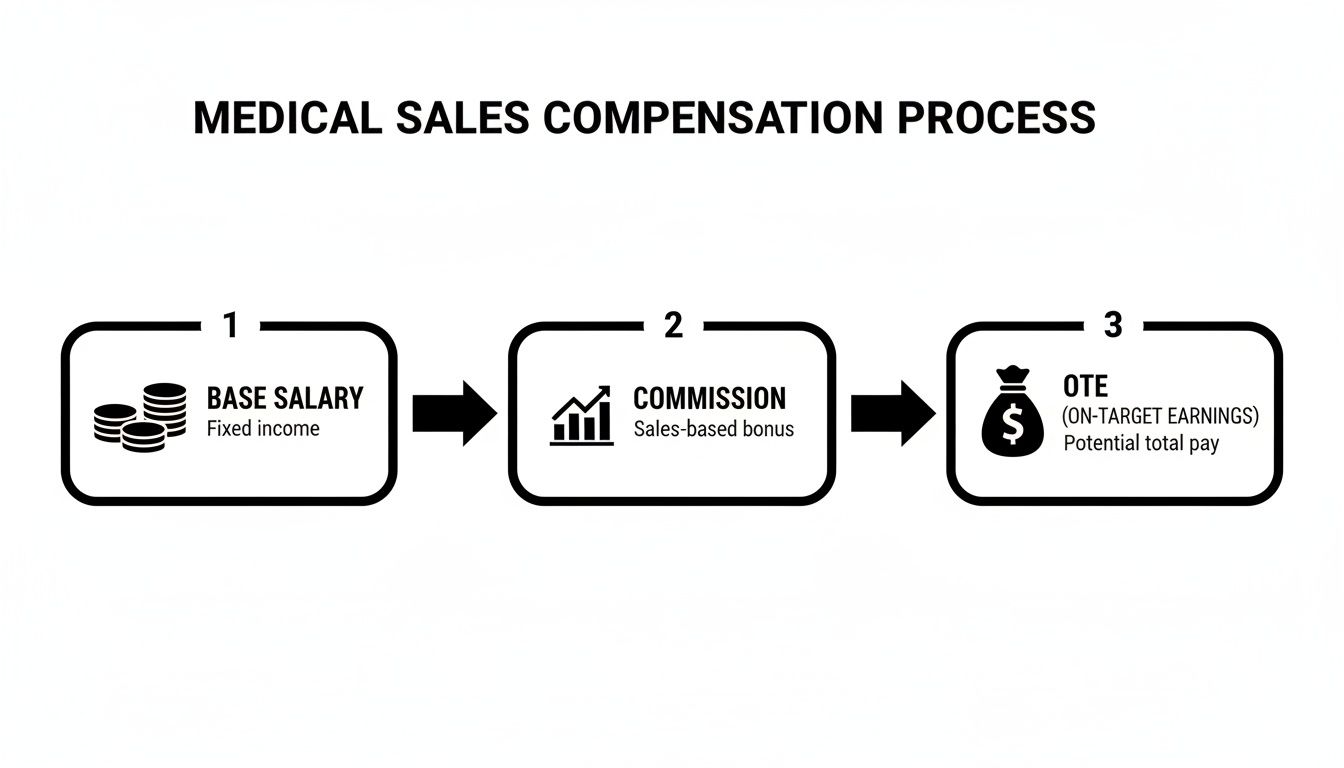
As you can see, the base provides stability, but the path to high six-figure or even seven-figure incomes is paved with commissions earned by crushing your sales goals.
A Real-World Scenario: Surgical Robotics
Let’s put some real numbers to this. Imagine you're a surgical robotics rep with a $100,000 base salary and $100,000 in commission at plan, giving you a $200,000 OTE. Your comp plan has a 1.5x accelerator for all revenue you bring in over your quota.
Here’s how your final pay can swing based on your performance:
Falls Short (80% of Quota): You still get your full base pay, plus 80% of your at-risk commission.
$100,000 (Base) + ($100,000 x 0.80) = $180,000 Total Earnings
Hits the Goal (100% of Quota): You’ve successfully hit your target and earned your full OTE.
$100,000 (Base) + $100,000 (Commission) = $200,000 Total Earnings
Crushes the Goal (120% of Quota): This is where those accelerators work their magic. You earn your base, your full commission, plus the accelerated bonus on the extra 20% you sold.
$100,000 (Base) + $100,000 (Commission) + ($20,000 in over-quota sales x 1.5 Accelerator) = $230,000 Total Earnings
Notice that a 20% overperformance didn't just add $20,000 to your pay—it added $30,000. That’s the power of a well-structured plan.
Crowdsourced data from platforms like RepVue confirms this across the industry, showing a direct line between high quota attainment and landing in the top percentile of earners. So, when someone asks, "how much do medical device reps make?" the only real answer is: it all comes down to your performance.
How Your Product Specialty Defines Your Paycheck
When someone asks "how much do medical device reps make?" there's never one straight answer. The single biggest factor that dictates your earning potential is what you sell. Simply put, not all devices are created equal, and neither are the paychecks for selling them.
The world of high-stakes, big-ticket surgical implants is a universe away from the high-volume, lower-cost business of medical disposables.
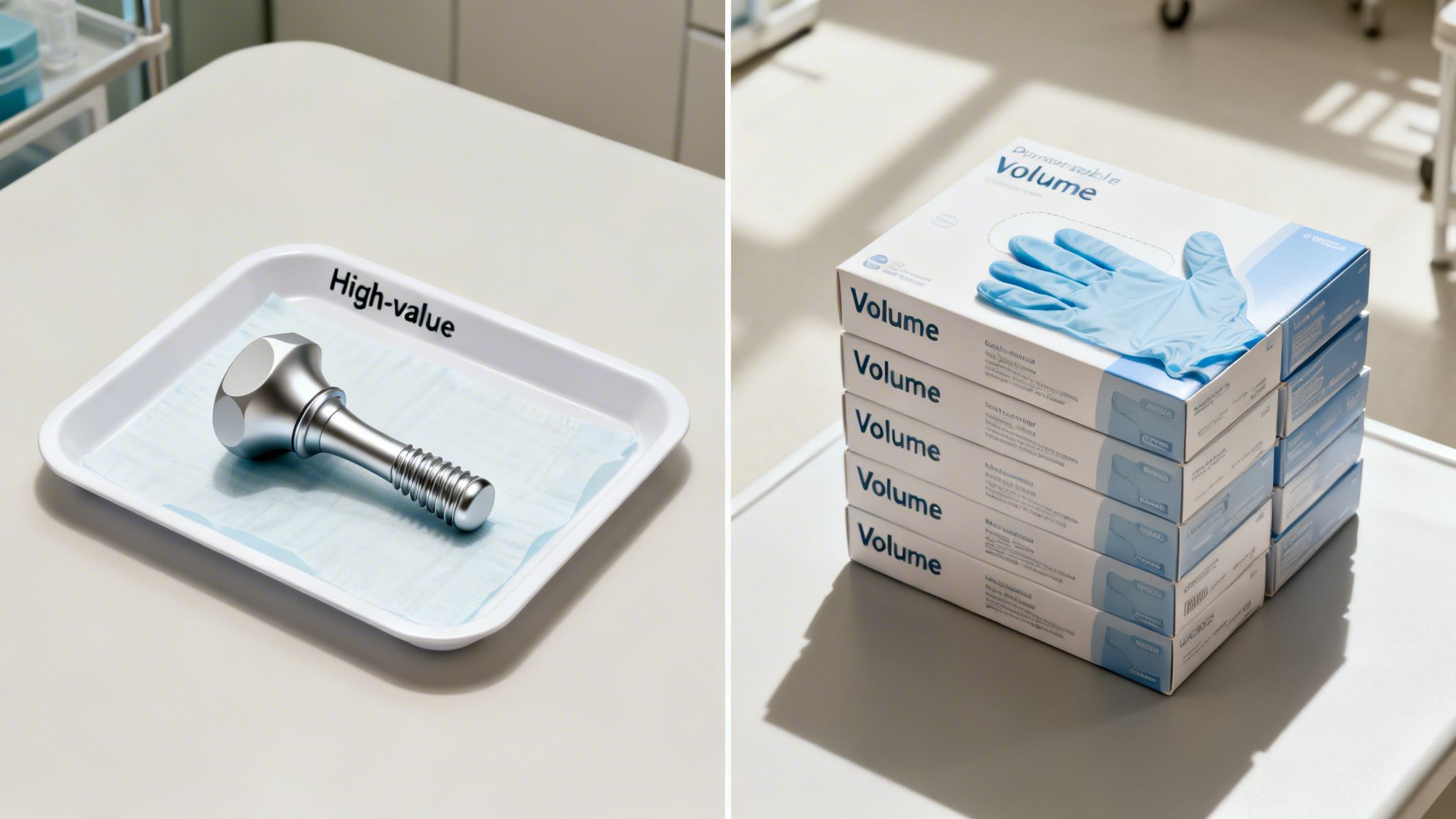
Here's a practical way to think about it. One rep might spend six months building a relationship to sell a single robotic surgery system for $2 million. At the same time, another rep is selling thousands of boxes of surgical gloves every single week to a dozen different hospitals.
Both jobs are essential, but their sales cycles, commission plans, and total pay couldn't be more different. The first is a "value" game; the second is all about "volume."
The High-Value vs. High-Volume Divide
The most lucrative jobs in medical sales almost always involve complex, expensive products that are absolutely critical to patient outcomes. These roles demand deep clinical knowledge and the ability to train surgeons. You’ll even find yourself in the operating room, guiding the procedure.
These top-tier specialties include:
Orthopedics & Spine: Selling implants for things like knee replacements or complex spinal fusions.
Cardiovascular: Focusing on pacemakers, stents, and artificial heart valves.
Surgical Robotics & Capital Equipment: Selling the massive, sophisticated systems used in the OR.
Neuromodulation: Specializing in advanced devices that treat chronic pain or neurological conditions.
On the other side of the coin, selling disposables or commodity products—think catheters, gloves, or basic surgical tools—is a numbers game. It's all about volume and efficiency. While these reps can certainly earn a good living, their commission on each sale is tiny, which means they need a constant churn of orders to hit their quota.
Why Ortho, Spine, and Cardiology Reps Lead the Pack
Breaking into specialties like orthopedics and spine is what often launches reps into the industry’s top earning bracket. We're talking median total pay in the $150,000 to $277,000 range. This is fueled by a massive increase in procedures from an aging population, where over 10% of people in many developed nations are now over 65.
These reps make their money on high-value procedures, with a single spinal fusion or joint replacement averaging $20,000 to $50,000. You can explore more salary data to see exactly how product specialization influences pay.
Cardiology operates on the same principle. Devices like transcatheter aortic valves (TAVR) or advanced pacemakers are both life-saving and incredibly expensive. A single successful procedure can generate a massive amount of revenue, which translates directly into a hefty commission for the rep who supported the case.
What really drives this pay gap? It comes down to expertise and risk. A spine rep in the OR is a technical consultant, making sure a $50,000 implant is used perfectly. A disposables rep is making sure the hospital's supply closet is stocked. Both are important, but one carries far more responsibility and, therefore, a much higher reward.
A Look at Earnings by Specialty
While your individual performance will always be the deciding factor, the product category you choose sets the stage for your earning potential. Here’s a general hierarchy of how much medical device reps make based on their specialty, from the highest potential OTE to the lowest:
Cardiovascular & Structural Heart: Often seen as the pinnacle of medical sales because of how critical and expensive the devices are.
Spine & Orthopedics: High-volume, high-cost procedures make this an incredibly lucrative field to be in.
Surgical Robotics & Capital Equipment: The sales cycles are long, but the commissions on multi-million dollar deals are enormous.
Surgical Instruments & Endoscopy: A solid middle-ground with consistent deal flow and very good commission potential.
Medical Disposables & Commodities: Lower commission per sale, but top reps who can manage huge territories and drive massive volume still do extremely well.
Choosing your specialty is one of the most important decisions you'll make in this career. It has a direct impact on your day-to-day work, the relationships you build, and, ultimately, your financial future in the industry.
Climbing the Earnings Ladder with Experience
In medical device sales, your first year’s paycheck is just the opening bid. Unlike many careers where your salary hits a ceiling after a few promotions, this field is built for sustained financial growth. Experience is the ultimate currency, and the more you have, the more you’re worth.
Think of it this way: your career is a journey with distinct financial milestones. As you move from a new associate to a seasoned veteran, your value—and your income—compounds. You’re not just getting older; you're building trust with surgeons, mastering hospital politics, and learning how to navigate the OR. That's a roadmap to a bigger paycheck.

The Proving Ground: Years 0-2
The first couple of years are your boot camp. As an Associate Sales Rep, your main job is to be a sponge. You’re learning the products inside and out, absorbing operating room etiquette, and figuring out who the key players are in your territory. Your compensation here is more stable, leaning heavily on your base salary.
You're essentially building your reputation from scratch. You’ll spend most of your time supporting senior reps, managing massive instrument trays, and making sure every detail is perfect for a procedure. The focus isn't on closing deals; it's on becoming the person everyone can count on when the pressure is on.
Your Mission: Master the product, learn the OR, and start building relationships.
Your Role: Support the lead rep and learn the ropes.
Your Paycheck: Mostly base salary with some smaller commission upside.
Mid-Career Acceleration: Years 3-9
This is where things get interesting. You've earned your stripes and are no longer just an associate—you’re running your own territory. All those hours you spent building connections are finally paying off. Surgeons now know you, trust you, and start asking for you by name.
At this point, your clinical expertise is sharp enough to confidently walk a surgeon through a challenging case. This level of skill allows you to protect your current business while aggressively taking market share from the competition. Your pay structure reflects this shift, with a much larger slice of your income coming directly from commissions.
It's in this window that reps really start to see their W-2s pop. Experience is the clear driver, pushing total compensation from the $60,000-$70,000 range in the early days to $78,000+ once you hit your stride in mid-career. You can find more data on the impact of experience on sales salaries in various reports.
Peak Earning Years: 10+ Years
Once you’ve been in the game for a decade, you’re in a different league entirely. You’re a pillar in your clinical community. You have rock-solid relationships with Key Opinion Leaders (KOLs), know your product portfolio better than the engineers who designed it, and can navigate a hospital’s value analysis committee in your sleep. You’re not just a rep anymore; you’re a strategic consultant to your surgeons and their hospitals.
This is where you command a top-tier income. It’s not uncommon for veterans with over 10 years of experience to see their total compensation fly past $208,498 a year. You know which accounts are goldmines, which are money pits, and exactly how to structure your week for maximum impact.
So, what causes that massive pay jump?
Unshakeable Relationships: Surgeons don't just like you—they rely on your expertise to deliver the best patient outcomes.
Strategic Vision: You see opportunities and competitive threats months before anyone else.
Pure Efficiency: You've mastered the art of working smart, not just hard, and you focus only on what drives results.
The career trajectory is clear: for those with the grit to stick it out, the financial rewards in medical device sales aren't just great—they're designed for incredible long-term growth. Every year you put in adds another layer of expertise, making you an indispensable partner to both your company and your customers.
How to Maximize Your Earnings and Join the Top 1%
Knowing the average salary is one thing. Actually breaking into the top tier of earners is a completely different ballgame. Moving from making a good living to truly building wealth in this field doesn’t happen by accident; it’s the result of a deliberate, strategic game plan.
The best reps I know all use some version of these tactics to blow past their quotas and secure their financial futures.
Nail Your Comp Plan Negotiation
Your long-term earning potential is largely decided the day you sign your offer letter. Don't be so eager to accept that you leave a fortune on the table. Before you even think about talking numbers, arm yourself with data on industry benchmarks for the role, the specific product line, and your city. Use that intel to build a case for a higher base or, even better, a killer commission structure.
When you get to the negotiating table, focus on these game-changers:
Accelerators: This is where the big money is made. Can you push for a 2x multiplier on sales over 100% of quota instead of the standard 1.5x? That difference alone can be worth tens of thousands of dollars.
Guarantees: If you're stepping into a struggling territory or launching a new product, a commission guarantee for the first one or two quarters is a must. It’s a crucial safety net while you ramp up and build your pipeline.
Kickers and Bonuses: Always ask about extra bonuses. Are there kickers for landing a major competitive account, hitting new product launch goals, or achieving specific growth targets? These add up quickly.
Run Your Territory Like a CEO
The highest earners don't just work harder; they work smarter. Think of your territory as your own business—you are the CEO. Instead of frantically chasing down every possible lead, you need to use data to figure out where the real money is and pour your energy there.
Start by pinpointing the surgeons and hospitals with the highest procedure volumes for your specific devices. Then, ask yourself the tough questions:
Which accounts have the most room to grow versus those that are already tapped out?
Where are my competitors showing weakness?
Which surgeons are the influential early adopters who will embrace new technology?
Perfecting your Sales Prospecting Best Practices is non-negotiable for finding these high-value targets and making sure you’re not just busy, but productive.
Specialize in a High-Growth, High-Margin Niche
We've seen how much your product category can swing your income. To really maximize your paycheck, you have to get into high-demand, high-margin specialties. It's no secret that fields like robotic surgery, structural heart, electrophysiology, and advanced biologics are blowing up right now.
Specializing in a complex, high-growth area makes you more valuable. As an expert in a niche like spinal robotics, you become an indispensable partner to surgeons, command a higher income, and build a more defensible career against market shifts.
Build Real Relationships with Key Opinion Leaders
In medicine, a trusted recommendation is worth more than gold. The real influencers are the Key Opinion Leaders (KOLs)—the highly respected surgeons who set the standard of care. Building genuine, long-term relationships with these physicians is a power play that pays off for years.
A KOL who trusts you and believes in your technology won't just be a great customer. They'll become your biggest advocate, championing your products at conferences, in medical journals, and to their colleagues. That kind of peer-to-peer endorsement is something no sales pitch can ever buy.
Become an Indispensable Clinical Partner
At the end of the day, the reps who make the most money are rarely seen as "salespeople." They are true clinical partners. This means you have to be obsessed with learning, knowing your devices, the anatomy, and the surgical procedures inside and out—often better than anyone in the room except the surgeon holding the scalpel.
When you can troubleshoot a technical issue mid-procedure or offer a piece of advice that makes the surgery run smoother, you build a foundation of unshakable trust. You stop being a vendor and become an essential part of the surgical team. When you are indispensable to your customers' success, your own financial success naturally follows. To see how this plays out, take a look at our guide on the nuances of selling to hospitals.
Common Questions About Medical Device Sales Salaries
After digging into the data, a few key questions always pop up, especially for people thinking about jumping into this career. Let's get straight to the answers you're probably wondering about.
What Is a Realistic First-Year Income for a Medical Device Rep?
Let's set a realistic target. For a new associate sales rep, your on-target earnings (OTE) will likely land somewhere between $80,000 and $110,000 in your first year.
Remember, year one is your training ground. You're learning the products, the surgeons, and the territory. Your primary focus is absorbing everything you can, but hitting your numbers can definitely push that income higher. This is a solid benchmark to plan around as you get started.
Is Medical Device Sales a Stressful Job?
In a word? Yes. There's no sugarcoating it—this job can be intense. The incredible earning potential is tied directly to performance, which means quotas, constant travel, and being on-call for surgeries that happen at all hours.
Patient care doesn't run on a 9-to-5 schedule, and neither will you. But if you're a resilient, organized person who thrives on competition, you'll find the stress is part of the challenge. The rewards, both financial and personal, often make it all worthwhile.
How Much Does Location Affect a Medical Device Rep's Salary?
Your territory plays a huge role in your paycheck. It’s no surprise that major medtech hubs like Boston, Minneapolis, and Southern California tend to have higher base salaries and OTEs.
Companies pay a premium in these areas to offset the higher cost of living and the fierce competition for talent. But don't sleep on the less-saturated markets. A top rep can absolutely crush it in a smaller territory by capturing a bigger slice of the market share.
A big salary in a big city looks great on paper, but a lower cost of living combined with untapped market potential can often put you in a much stronger financial position. Don't overlook the "flyover" states.
Success in this field is a unique mix of clinical smarts, sales drive, and strategic planning. If you want to dive deeper into the world of medical sales, check out our other guides on the G LNK blog.
At G LNK, we provide the world's largest clinician database to help commercial teams target the right physicians, understand procedure volumes, and build winning sales strategies. Request a demo to see how our platform can accelerate your growth.