Nov 13, 2025
Mastering selling to hospitals: A 2026 Playbook for MedTech

Master modern strategies for selling to hospitals with evidence-backed value, procurement insights, and practical deal-closing tactics.
If you’ve ever tried to sell into a hospital, you know it’s a world away from a typical B2B sales cycle. The old playbook of wining and dining a single decision-maker just doesn't cut it anymore. You’re not just selling a product; you’re trying to become part of a complex ecosystem that’s balancing clinical needs, tight budgets, and a web of internal politics.
Success means you have to speak three different languages—clinical, financial, and operational—often all in the same meeting. You have to prove, with hard evidence, how you improve patient outcomes, make a clinician's life easier, and ultimately lower the total cost of care for the institution.
Cracking the Code of Hospital Sales
So, why do so many traditional sales tactics fail spectacularly in healthcare? It mostly comes down to a massive, ongoing shift in the market: physician consolidation. As of 2024, a staggering 47% of all physicians are now direct employees of hospital systems. That’s a huge jump from just 29% back in 2012.
This isn't just a statistic; it's a fundamental change in how buying decisions are made. The days of a single physician championing your product and getting it approved are fading fast. Decisions are now made at the system level, aligning with broad strategic goals, not just individual preference. This can feel like a roadblock, but it's also a massive opportunity. Cracking one major health system can lead to rapid, system-wide adoption that you’d never achieve by targeting one small practice at a time.
A Modern, Insight-Driven Approach
In this new environment, what you know is far more important than who you know. Building a strategy on a solid foundation of data isn't optional—it's the only way to compete.
For example, do you know which electronic health record (EHR) system your target hospital uses? It sounds simple, but it’s a critical piece of the puzzle. Recent data shows Epic Systems dominating the market with 41.3% of U.S. hospitals, while Oracle Cerner holds 21.8%. If your solution integrates seamlessly with Epic, you already have a powerful, data-backed reason to focus your efforts on that 41.3% of the market first.
Selling to a hospital is a team sport. Your clinical champion might get you in the door, but it’s the combined support from finance, IT, and administration that gets the deal signed. You have to build a multi-threaded business case that speaks directly to what keeps each of them up at night.
This guide is designed to give you that modern playbook. We’ll walk through how to:
Map the Key Players: Forget generic buyer personas. We’ll show you how to identify the real economic buyers, find your clinical champions, and get ahead of the technical reviewers in every single account.
Build an Evidence-Based Case: Learn to frame your solution's value around the metrics that actually matter to hospitals: clinical efficacy, operational efficiency, and a clear financial ROI.
Navigate Procurement and GPOs: We’ll demystify the roles of the Value Analysis Committee (VAC) and Group Purchasing Organizations (GPOs), so you know exactly what to expect.
By putting these strategies into practice, you’ll be building a much more effective and predictable sales motion. For commercial teams wanting to get a serious head start, a unified healthcare data platform like the one we've built at G-LNK gives you the specific insights needed to find and win your best opportunities faster.
Mapping the Terrain: Hospitals and Their Gatekeepers
Anyone who's spent time selling into the healthcare space knows one fundamental truth: if you've seen one hospital, you've seen one hospital. A massive urban academic medical center and a 50-bed rural community hospital might as well be on different planets in terms of their priorities, pressures, and purchasing processes.
Before you even think about picking up the phone, your first job is to map this landscape. This isn't just about finding hospitals on a map; it's about qualifying them. You need to dig into the data to find the institutions where your solution isn’t just a "nice-to-have," but a "must-have."
Start by looking at a few key indicators:
Size and scale: Is it a 500+ bed system or a small, independent facility? The complexity of the sale and the potential deal size are directly tied to bed count.
Payer mix: What’s their blend of Medicare, Medicaid, and private insurance? A hospital with a high Medicare population is going to be laser-focused on anything that impacts federal reimbursement, like readmission penalties.
Tech stack: What EHR are they running? Knowing if a hospital is on Epic, which dominates with 41.3% of the U.S. market, or Oracle Cerner (21.8%) is absolutely critical if your product needs to integrate. A mismatch here can be a non-starter.
This all comes down to connecting what you sell to what they need, what they can afford, and who has to say yes.
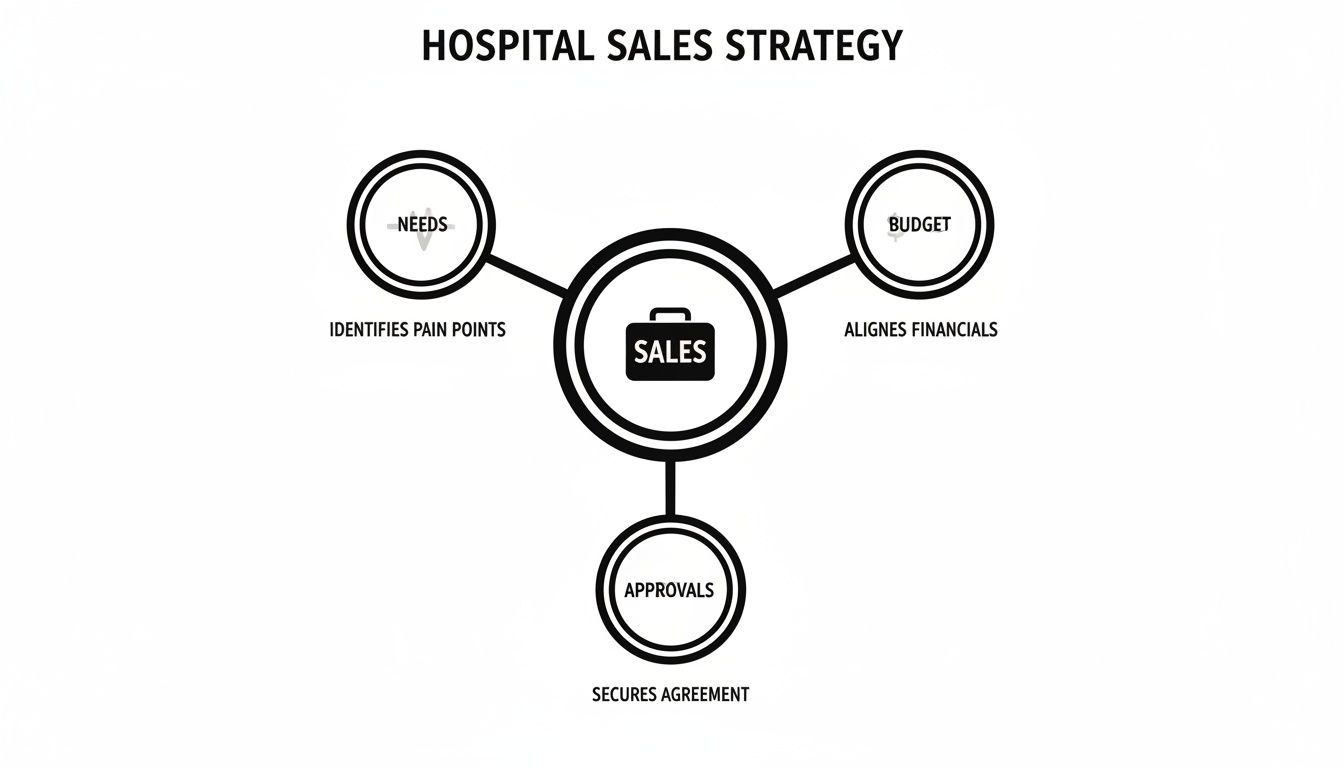
As you can see, a deal only happens at the intersection of a real clinical need, a viable budget, and the approval of all the necessary gatekeepers. Getting one or two isn't enough.
Assembling the Buying Committee
Once you have a shortlist of target hospitals, your focus has to zoom in from the institution to the individuals inside. Generic personas are fine for marketing, but for a complex sale, you need to map the very real people who form the Decision-Making Unit (DMU). This is the group—sometimes formal, often informal—that holds the collective power to green-light or kill your deal.
Your job isn't just to find one champion. It's to build a coalition. A single "yes" from a doctor is a great start, but it's easily overturned by a "no" from finance or IT. You have to identify and align every key stakeholder.
In my experience, nearly every hospital deal comes down to navigating the needs of four distinct roles. Even in a smaller hospital where one person might wear multiple hats, these functions are always present.
The Key Players in Every Hospital Deal
The Clinical Champion This is your advocate on the inside. Often a physician, department head, or service line director, they feel the pain your solution solves every single day. They are passionate about improving patient outcomes or fixing a broken workflow. Your champion will be the one who helps you navigate the internal politics and gives you credibility.
The Economic Buyer This is the person who controls the purse strings—think the CFO, VP of Finance, or a powerful administrator. They are measured on the financial health of the institution, so they care about one thing above all else: return on investment. Your conversations with them should be about hard numbers, cost savings, and how your solution contributes to the hospital's bottom line.
The Technical Reviewer This person’s job is to say "no." Usually sitting in IT, cybersecurity, or the legal department, their role is to identify and mitigate risk. They'll scrutinize your solution for HIPAA compliance, data security vulnerabilities, and interoperability with existing systems. A thumbs-down from them can stop a promising deal dead in its tracks.
The End-Users These are the people on the front lines who will actually use your product—the nurses, techs, and staff physicians. While they rarely have direct purchasing power, their influence is massive. If they find your solution clunky, complicated, or disruptive to their workflow, adoption will fail. A bad pilot due to user resistance is a guaranteed way to kill any chance of a wider rollout.
Hospital Decision-Making Unit (DMU) Roles and Priorities
To truly align your sales process, you have to speak each stakeholder's language. This table breaks down who they are, what they care about most, and how you can effectively engage them.
Role | Primary Focus | How to Engage Them |
|---|---|---|
Clinical Champion | Patient outcomes, clinical efficiency, innovation, quality of care | Arm them with clinical evidence, case studies, and a clear story of how your solution improves their daily work and patient lives. |
Economic Buyer | ROI, cost reduction, budget alignment, revenue generation | Present a clear financial model. Focus on cost savings, efficiency gains, and how your product impacts key financial metrics. |
Technical Reviewer | Security, compliance (HIPAA), interoperability, data integrity | Be proactive. Provide detailed security documentation, an integration plan, and clear answers about data management and compliance. |
End-User | Ease of use, workflow integration, time savings, intuitive design | Involve them early through demos and pilots. Show them how your solution makes their job easier, not harder. Listen to their feedback. |
Think about selling an AI-powered surgical planning tool. The Chief of Surgery (your Clinical Champion) might be captivated by its potential to improve precision. But the CFO (Economic Buyer) will demand a rigorous cost-benefit analysis. Meanwhile, the IT Director (Technical Reviewer) will want ironclad proof of data security and EHR integration, and the surgeons themselves (End-Users) need to be convinced it actually simplifies their pre-op planning.
If you ignore any one of these players, you're not just risking a delay—you're risking the entire deal.
Building a Value Proposition Backed by Hard Evidence
When you’re selling to hospitals, features don't close deals—outcomes do. Your success hinges less on what your product is and more on the tangible results it delivers. A powerful, evidence-based value proposition isn’t just a nice-to-have; it’s the absolute foundation of your sales strategy in healthcare.
You have to build a business case that resonates with every single stakeholder you’ve identified. A physician champion wants to see clinical efficacy. A department head needs to know it will improve their team's workflow. And the CFO? They only care about the financial ROI. Your job is to connect the dots for all of them, with undeniable proof.

This takes more than just a slick presentation. It demands a thoughtful evidence strategy that anticipates questions and proves your worth using the same metrics hospitals are judged on.
From Technical Specs to Impact Stories
Too many companies get bogged down in technical details. But here’s the reality: your buyers don’t care about the sophisticated algorithm in your software or the proprietary material in your device. They care about what it means for their patients, their staff, and their bottom line.
Let's imagine you sell an AI-powered patient monitoring system. Your messaging needs to transform depending on who you're talking to.
For your Clinical Champion (the Head of ICU): Don't talk about machine learning models. Instead, show them the pilot study where your system’s predictive analytics led to a 25% reduction in code blue events. Frame it as giving their clinical team a crystal ball to intervene before a crisis, not just react to one.
For the End-User (an ICU Nurse Manager): Forget the hardware specs. Focus on how the streamlined dashboard cuts down on alarm fatigue and gives each nurse back 30 minutes per shift that they used to spend manually charting vitals. That’s a powerful story of workflow relief.
For the Economic Buyer (the CFO): This is where you talk money. Present a clear financial model. Show them that by reducing the average ICU length-of-stay by just one day for 10% of their patients, the hospital can realize over $1.2 million in annual cost savings.
It’s the same product, but you’re telling three different stories. You aren't changing the facts; you're simply changing the lens to match the priorities of your audience.
The Hierarchy of Evidence
Not all proof is created equal, and timing is everything. You need to think of your evidence as a tiered arsenal that you deploy strategically as you move deeper into the sales process.
A single peer-reviewed article might capture a physician's interest, but it's the real-world data from a pilot program at a sister hospital that will convince the C-suite. Your evidence strategy must scale from academic validation to tangible, local proof.
Your evidence portfolio should be a deliberate mix of the following:
Tier 1: Foundational Clinical Data: This is your entry ticket. It includes randomized controlled trials (RCTs) and peer-reviewed publications. This is the gold standard for establishing clinical credibility and is absolutely essential for getting your physician champion to take you seriously.
Tier 2: Real-World Evidence (RWE): This is where things get interesting. RWE is data gathered from outside a formal trial—think patient registries, claims data, or, most powerfully, your own pilot programs. It demonstrates how your solution performs in the messy, unpredictable environment of an actual hospital, which is far more compelling than a controlled study.
Tier 3: Economic Models and ROI Calculators: These are your closing tools. They translate all that great clinical and operational data into the language of the C-suite: dollars and cents. The key here is to make it interactive. Work with your champion to plug in the hospital's own numbers—staffing costs, readmission penalties, supply expenses—to build a customized business case they can own and defend.
For example, a medical device company can use RWE from a similar-sized hospital to show its new implant has a lower revision rate than a competitor's. That directly speaks to the bottom line by proving a reduction in costly and complex follow-up surgeries.
Aligning with Hospital Quality Metrics
The most sophisticated value propositions go one step further. They tie your product's impact directly to the quality metrics that hospitals are publicly measured and reimbursed on. These aren't just internal goals; they are high-stakes indicators that affect a hospital’s reputation and financial health.
Focus on connecting your solution to metrics that keep hospital executives up at night:
Hospital-Acquired Conditions (HACs): Prove how your solution reduces rates of things like central line infections (CLABSIs), catheter-associated UTIs (CAUTIs), or patient falls.
Readmission Rates: Demonstrate a clear, data-backed link between your product and fewer 30-day readmissions for high-priority conditions like heart failure or COPD.
Length of Stay (LOS): Provide hard evidence that your product helps patients get home safely and more quickly, freeing up valuable beds.
Patient Satisfaction Scores (HCAHPS): Connect the dots between your solution and a better, more comfortable patient experience, which directly impacts these publicly reported scores.
When you build your business case around these metrics, you stop being just another vendor. You become a strategic partner. You're no longer selling a product; you’re offering a clear, evidence-backed solution to their most pressing challenges. As you begin to build these financial models, getting the full picture of the costs involved is crucial. For more on this, see our detailed guide on pricing and contracting in this complex market.
Getting Past Procurement: GPOs, Value Committees, and Shifting Budgets
So you’ve found your clinical champion. They love your product, they see the value, and they’re ready to fight for it. That's a huge win, but don’t start celebrating just yet. Many promising deals die a slow death right here, caught in the tangled web of hospital procurement.
This is where the rubber meets the road—where your carefully crafted business case runs headlong into the financial and operational realities of a health system. Getting your clinical champion’s “yes” was the first step. Now, you need the institutional “yes,” and that means winning over a whole new cast of characters: procurement managers, the Value Analysis Committee (VAC), and often, a powerful Group Purchasing Organization (GPO).
The GPO and IDN Gauntlet
If you're new to selling into hospitals, you need to understand Group Purchasing Organizations. These are the titans of the industry. GPOs work by bundling the purchasing power of many different hospitals to negotiate rock-bottom prices from vendors. With over 98% of U.S. hospitals belonging to at least one GPO, they hold immense sway over what gets bought and for how much.
Integrated Delivery Networks (IDNs) are a different flavor of the same concept. Think of massive, unified health systems like Kaiser Permanente or HCA Healthcare. They essentially act as their own GPO, centralizing all purchasing decisions across their network of hospitals and clinics. Landing a deal with an IDN can be a long, grueling process, but a single contract can unlock system-wide adoption and massive scale.
Getting 'on-contract' with a major GPO like Vizient or Premier can feel like a golden ticket. It creates a pre-vetted pathway into their member hospitals and can dramatically shorten your sales cycle. The trade-off? Brutal price pressure and rigid terms. On the flip side, going 'off-contract' means you’ll have more explaining to do, but you gain crucial negotiating flexibility—if you can prove your solution is truly unique.
Facing the Value Analysis Committee
Before your product gets anywhere near a purchase order, it has to pass muster with the Value Analysis Committee (VAC), sometimes called a VAT. Think of them as the ultimate gatekeepers for any new technology. This isn't just one person; it's a cross-functional team of clinicians, supply chain experts, finance reps, and administrators.
Their entire job is to poke holes in your proposal. They'll question your clinical data, scrutinize your cost-benefit analysis, and challenge your implementation plan. They've seen it all, and they’re not easily impressed.
To survive the VAC, your strategy needs to be flawless.
Prep your champion. Your clinical advocate is your voice in that room. They need to be armed not just with data, but with the confidence and conviction to defend your solution against tough questions. Role-play with them.
Leave no stone unturned. Your submission package has to be airtight. That means all your clinical evidence, a crystal-clear financial breakdown, and a detailed plan for training and support.
Think like they do. What are their biggest fears? Cost overruns? Disrupting clinical workflows? IT integration headaches? Address these potential objections head-on in your proposal before they even have a chance to ask.
A successful VAC review isn't a sales pitch. It’s a collaborative problem-solving session where you position yourself as a partner who understands their challenges, not just another vendor pushing a product.
Partnering with Procurement When Budgets Are Tight
Hospital budgets are anything but predictable. They shift constantly with economic tides, healthcare policy changes, and new institutional priorities. Trying to sell a high-cost item during a budget freeze can feel impossible, but it’s not. The key is to stop seeing procurement as an obstacle and start treating them as a strategic partner.
Their priorities are changing, too. A recent hospital purchasing behavior report from NAMSA surveying 100 hospital decision-makers found that while 49% saw their procurement budgets increase, the reasons varied by geography. In the U.S., growth was driven by new AI tools and a push for efficiency (46% growth). In Europe, the focus was on digital integration and modernization (52% growth). This insight underscores a key point: strong, relevant data opens doors.
This tells you everything you need to know. You absolutely can secure funding, even in a tough climate, if you tie your solution directly to the hospital’s most pressing strategic goals.
Is the C-suite obsessed with cutting operational expenses? Then your pitch should be all about efficiency, throughput, and cost savings. Are they trying to position themselves as a center for cutting-edge care? Then you lead with your product's clinical superiority and patient outcomes.
Treat procurement professionals like the internal consultants they are. Their job isn’t just to get the lowest price; it's to find the best value. Give them a powerful economic case and show them exactly how you help the institution win. When you make their job easier and help them look good to the finance department, they will fight for you when it's time to allocate the money.
Your Pilot-to-Scale Playbook
There's no more powerful sales tool in a hospital setting than a successful pilot program. It's your chance to turn your solution from a theoretical promise on a slide deck into undeniable proof right inside their own four walls. Get it right, and it’s your springboard from one department to an enterprise-wide contract.
But a word of caution: a poorly planned pilot is worse than no pilot at all. I've seen them burn a good clinical champion, waste everyone's time, and slam the door shut on any future conversations. A great pilot, on the other hand, builds its own momentum. It becomes the heart of your business case and creates a groundswell of internal support that’s tough for any committee to ignore. The goal is simple: move the conversation from "This might work for us" to "We need this everywhere."
This all starts by working hand-in-glove with your clinical champion to design a program that’s built to win from day one.
Designing a Pilot with Airtight Success Metrics
Before anyone touches a piece of software or a new device, you have to define what success looks like. And you have to do it with your internal advocate. These metrics can't be fuzzy goals like "improve efficiency"—that’s useless. They need to be specific, measurable, and tied directly back to the value proposition you’ve been building all along.
Think in terms of concrete Key Performance Indicators (KPIs) that will speak to everyone on the decision-making team, from the CFO to the head of nursing.
For a clinical device: You might aim for a 15% reduction in average procedure time or a 10% drop in a specific post-op complication.
For a software platform: Focus on what the users will feel. Think about reducing documentation time by 20 minutes per nurse, per shift, or cutting patient scheduling errors by 50%.
For a diagnostic tool: A powerful metric could be shortening the time-to-diagnosis from 48 hours down to just 12.
These aren't just numbers; they become the headlines of the business case you'll eventually take to the Value Analysis Committee (VAC) and the economic buyer. Your champion must not only agree to these metrics but also commit to helping you gather the data to prove them.
A pilot isn't just a product trial; it's a data collection exercise. The whole point is to generate irrefutable, institution-specific evidence that makes the decision to scale a no-brainer. Without clear, agreed-upon metrics, you're just running a free demo.
Nailing the Implementation and Support
Once your metrics are locked in, it's all about execution. The single biggest threat to any pilot is a clunky user experience. If your solution is seen as a burden, difficult to use, or unsupported, it’s dead on arrival—no matter how great the tech is. Your implementation has to be flawless.
This means providing true white-glove support. You need a dedicated point of contact for the pilot team, on-site training (and re-training), and an almost obsessive responsiveness to any hiccup. The goal is to make the pilot users feel like partners in innovation, not guinea pigs. When you proactively ask for their feedback, you not only iron out wrinkles in your product but also start turning frontline staff into your biggest advocates for a wider rollout.
Staying Compliant as You Grow
Moving from a small pilot to a broader partnership is exciting, but this is also where compliance risks creep in. As you engage more closely with physicians and other Healthcare Professionals (HCPs), every single interaction and transfer of value needs to be meticulously tracked. This is critical for staying on the right side of regulations like the Sunshine Act.
This is absolutely non-negotiable. According to the Centers for Medicare & Medicaid Services, companies reported over $12.13 billion in payments under the Open Payments program in 2022. A single misstep here can lead to huge fines and, even worse, destroy the trust you've worked so hard to build.
To protect your company and your reputation as you scale, you have to get this right:
Track Everything: Document every meeting, meal, consulting fee, or travel reimbursement you provide to an HCP. No exceptions.
Use FMV Benchmarks: When you compensate an HCP for their time—for example, for consulting on pilot results or training other users—make sure that payment aligns with established Fair Market Value (FMV) benchmarks for their specialty and experience.
Use Integrated Data Tools: This process is much easier with a platform that has compliance data built-in. For instance, a tool like G-LNK lets you see an HCP’s Open Payments history, helping you ensure your engagements are appropriate and compliant from the very start.
By baking compliance into your scaling playbook from the beginning, you build a foundation of trust. It shows you're a serious, professional organization ready for a true enterprise-level partnership, protecting both your company and your hospital clients for the long haul.
Using Data and Technology for a Smarter Sales Strategy
Relying on old contacts and gut feelings to sell into hospitals just doesn't cut it anymore. Winning in this space means you have to be precise. The best teams I've worked with are those who lean heavily on modern healthcare data platforms that bring together physician profiles, institutional intelligence, and market dynamics all in one place. It’s about replacing guesswork with a sharp, targeted strategy that moves the sales process forward, faster.
Think about it. What if you could instantly identify the perfect Key Opinion Leader (KOL) for your new device? Then, with a few clicks, layer on procedure volume data to find the busiest surgeons and see exactly who they're getting referrals from. That’s not a "nice-to-have" anymore; it's the new baseline for high-performing commercial teams.
Weaving Intelligence into Your Daily Workflow
This kind of intelligence is only powerful if your team actually uses it. The key is to get the data out of a standalone dashboard and right into their daily workflow by connecting it to your CRM, whether that's Salesforce, Veeva, or another system. This gives your sales organization a living, breathing map of their territory.
When you get this integration right, you unlock some serious advantages:
Smarter territory planning. You can now send your reps where the opportunity actually is, based on real-time procedure volumes and hospital priorities, not just old ZIP code assignments.
Targeted, relevant outreach. Imagine launching a campaign that speaks directly to a physician's specific practice patterns or a health system’s newly announced goals. It’s a game-changer.
More strategic conversations. Your field team can walk into meetings already knowing the landscape. This lets them skip the basic discovery questions and jump right into a strategic, problem-solving discussion.
In an environment where hospital budgets are under intense pressure, this data-driven approach is also how you prove your product's financial worth. To get a deeper look at this dynamic, you can find more of our insights on how to build a data-driven sales strategy that actually connects with buyers.
A modern healthcare data platform brings all these different data points together into a clear, actionable view for your team.
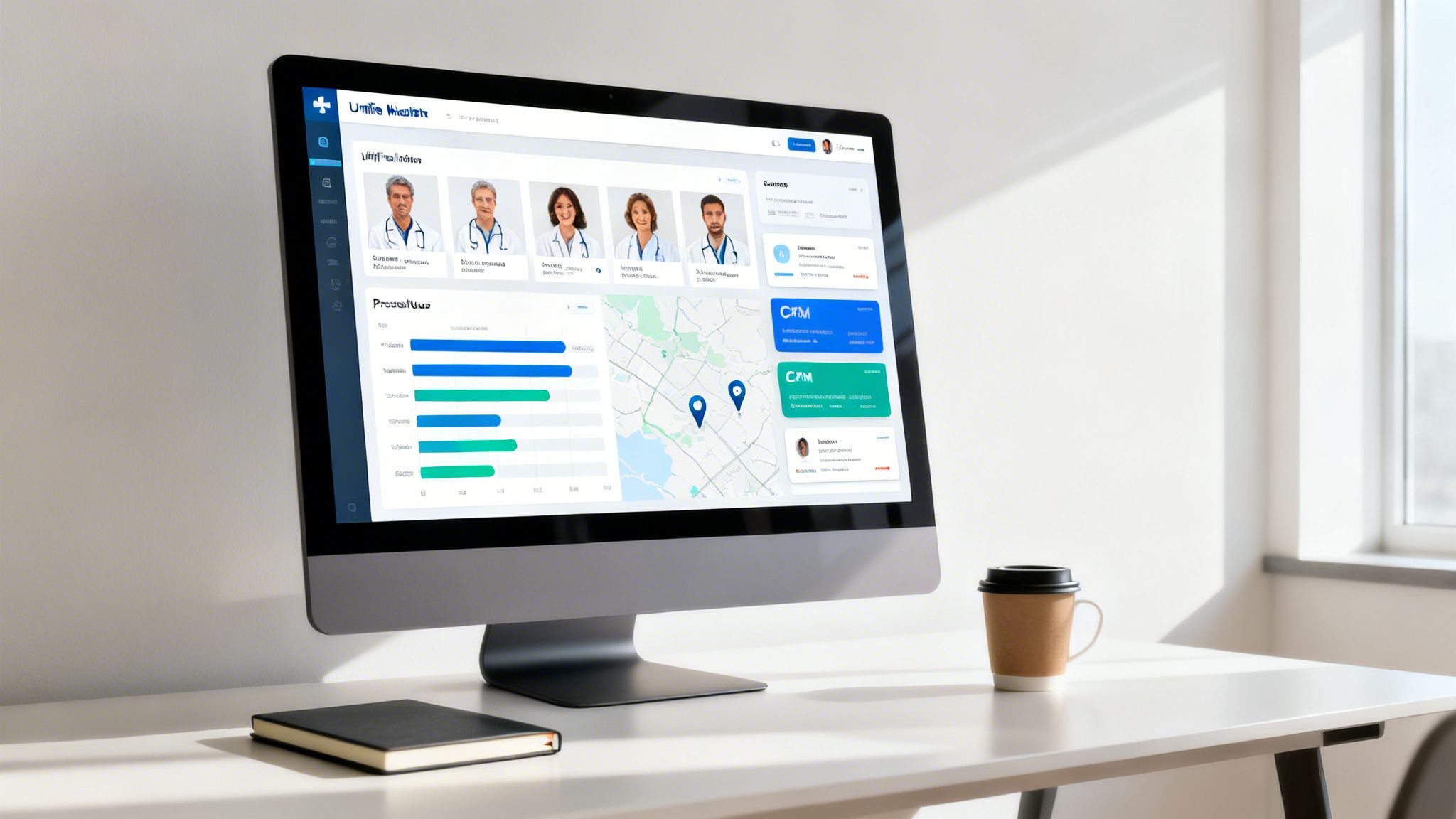
The dashboard above is a great example of how you can visualize institutional data, clinician profiles, and market trends together. This allows teams to quickly spot opportunities and build their engagement plan on the fly.
Proving Your Value with Hard Market Data
The financial reality for U.S. hospitals is tough. The IQVIA report on global medicine spending paints a clear picture: while global spending is projected to reach $1.6 trillion by 2026, the U.S. market faces flat 0-3% net price growth, driven by increased rebates and discounts. This is a critical insight for any team selling in this market.
This financial squeeze means your value proposition has to be rock-solid. You need comprehensive claims data that clearly shows how your product makes a real-world difference in treatment patterns, patient outcomes, and, most importantly, the bottom line.
By putting unified data at the center of your strategy, your sales team can stop being just another vendor and start being a true strategic partner. You'll be able to walk in with a deep understanding of a hospital's specific challenges and present your solution with undeniable, institution-specific evidence.
Frequently Asked Questions
How Long Does a Typical Hospital Sales Cycle Take?
Patience is a virtue in this world. A realistic timeline for selling into a hospital or health system is anywhere from 6 to 24 months. It’s a huge range, I know, but it really comes down to the complexity and cost of your solution.
A simple, low-cost disposable that’s already on a Group Purchasing Organization (GPO) contract? You might push that through in under a year. But if you’re selling major capital equipment or a new software platform that needs its own budget line and touches multiple departments, you should absolutely plan for the long haul—closer to that two-year mark.
What Is the Biggest Mistake Sales Teams Make?
Without a doubt, it’s falling in love with your clinical champion and assuming their enthusiasm is enough to get the deal done. It never is. I’ve seen countless promising deals wither on the vine because the sales team never moved beyond that one friendly physician.
That doctor might love your device, but they aren't the one signing the check. Your deal will die in committee if you can't build a rock-solid business case for the financial buyers and successfully guide it through the Value Analysis Committee. You have to sell to the entire group of decision-makers, not just one.
How Can I Find a Hospital's GPO Affiliation?
This can feel like trying to find a needle in a haystack, as hospitals don't usually advertise this information. Your most direct route is to use a dedicated healthcare intelligence platform. Tools that track institutional data will have GPO and Integrated Delivery Network (IDN) affiliations mapped out for you.
If you don't have access to a platform like that, the old-fashioned way still works. Simply ask. When you're in those early discovery calls with contacts in supply chain, materials management, or even department leadership, just ask them directly. Knowing which GPO they belong to early on is critical for shaping a pricing and contracting strategy that will actually work.
Accelerate your hospital sales strategy with a single source of truth for clinician, institution, and market data. G LNK gives your team the insights needed to find, engage, and win your best opportunities. Explore our platform today.