
Nov 13, 2025
Decoding the Average Medical Sales Salary in 2026

What is the average medical sales salary in 2026? This guide breaks down compensation, roles, and how to maximize your earnings with real-world data.
So, what does a medical sales salary actually look like in 2026? The short answer: it’s a wide range, but the earning potential is significant. It's not uncommon to hear about total compensation packages hitting well over $150,000, especially for seasoned reps.
But that single number can be misleading. The real story is in the details—the mix of base pay, commission, your specific role, and even where you live.
What Is a Realistic Medical Sales Salary in 2026?
When you’re trying to figure out a realistic salary, you have to look at the entire compensation package. In medical sales, your income is almost always a combination of a guaranteed base salary and a variable, performance-based component. This structure is what creates such a broad spectrum of potential earnings.
To get a real-time pulse on the market, both companies and candidates can look at aggregated data from job sites. For instance, using a Glassdoor Salaries Scraper can pull together current salary information, giving you a solid baseline for what's competitive right now.
Deconstructing the Numbers
Let's break down what the data tells us. The numbers can look quite different depending on which part of the industry you’re in. Pharma sales, for example, often has a more structured and predictable progression.
One report from early 2026 shows the average base for a pharmaceutical sales rep is around $72,525. But look at the range: the 25th percentile is at $44,000, while the 75th percentile hits $81,500. The top 10% of earners? They're pulling in $109,500 or more, according to ZipRecruiter's pharma salary data.
That’s a huge gap, and it clearly shows how much performance matters. And remember, that’s just pharma. Once you factor in high-stakes fields like surgical devices or biotech, those averages can climb even higher.
To give you a clearer picture, the table below summarizes what you can expect across the broader medical sales industry. It breaks down compensation to illustrate the full earning potential, from entry-level to top-performer status.
Average Medical Sales Salary Snapshot for 2026
This table summarizes the average compensation for a medical sales representative in the U.S., including percentile breakdowns to show the full earning spectrum.
Metric | Average Figure | Percentile Breakdown |
|---|---|---|
Annual Salary | $120,000 - $160,000 (OTE) | 25th Percentile: $85,000 |
Monthly Salary | $10,000 - $13,333 (OTE) | 75th Percentile: $180,000 |
Hourly Rate (Est.) | $57 - $77 (OTE) | 90th Percentile: $210,000+ |
As you can see, your On-Target Earnings (OTE)—the total you make if you hit 100% of your sales quota—is where the real money is. A modest base salary can quickly be overshadowed by a strong commission check.
Key Factors Shaping Your Salary
It’s crucial to understand that the "average" salary is just a starting point. Several key factors will ultimately shape your personal income:
Your Role: A surgical device rep who spends their day in the operating room has a completely different sales process—and compensation plan—than a pharma rep calling on family practices.
Your Experience: A rep just starting out is in a different league than a 10-year veteran with a rock-solid book of business and deep physician relationships.
Your Location: Selling in a major med-tech hub like Boston or San Francisco will almost always come with a higher salary to offset the cost of living and the sheer concentration of major health systems.
Think of these factors as dials that can turn your earning potential up or down. We'll dig deeper into each of these variables in the sections that follow.
How Medical Sales Compensation Packages Actually Work
If you're just looking at a single "average medical sales salary" number, you're missing the forest for the trees. To get a real sense of what you can earn, you have to break down the entire compensation package. Think of it less as a single salary and more as a recipe with a few key ingredients that determine the final payout.
The two main components you’ll always see are base salary and variable pay. Your base salary is the foundation—it's the predictable, guaranteed income that hits your bank account every pay period, no matter what. It’s the money you can count on to pay the bills.
Variable pay, on the other hand, is where things get exciting. This is your commission and bonus structure, the part of your pay that’s tied directly to your performance. When you crush your sales targets, this is the component that makes your paycheck soar. It’s the reason medical sales offers such high earning potential; your success is rewarded in a very tangible way.
Understanding Your On-Target Earnings
When you put the base salary and the potential variable pay together, you get a critical number called On-Target Earnings (OTE). Your OTE is the total amount of money you'll make if you hit 100% of your sales quota for the year. This is the true number you should use to compare job offers.
Let's walk through a quick example. A company might put an offer on the table that looks like this:
Base Salary: $80,000
Variable Pay (at 100% of quota): $60,000
In this case, your OTE is $140,000. That's the figure that represents the job's full financial potential, not just the guaranteed portion.
The spectrum of what's possible is wide, and performance is the great differentiator, as this chart shows.
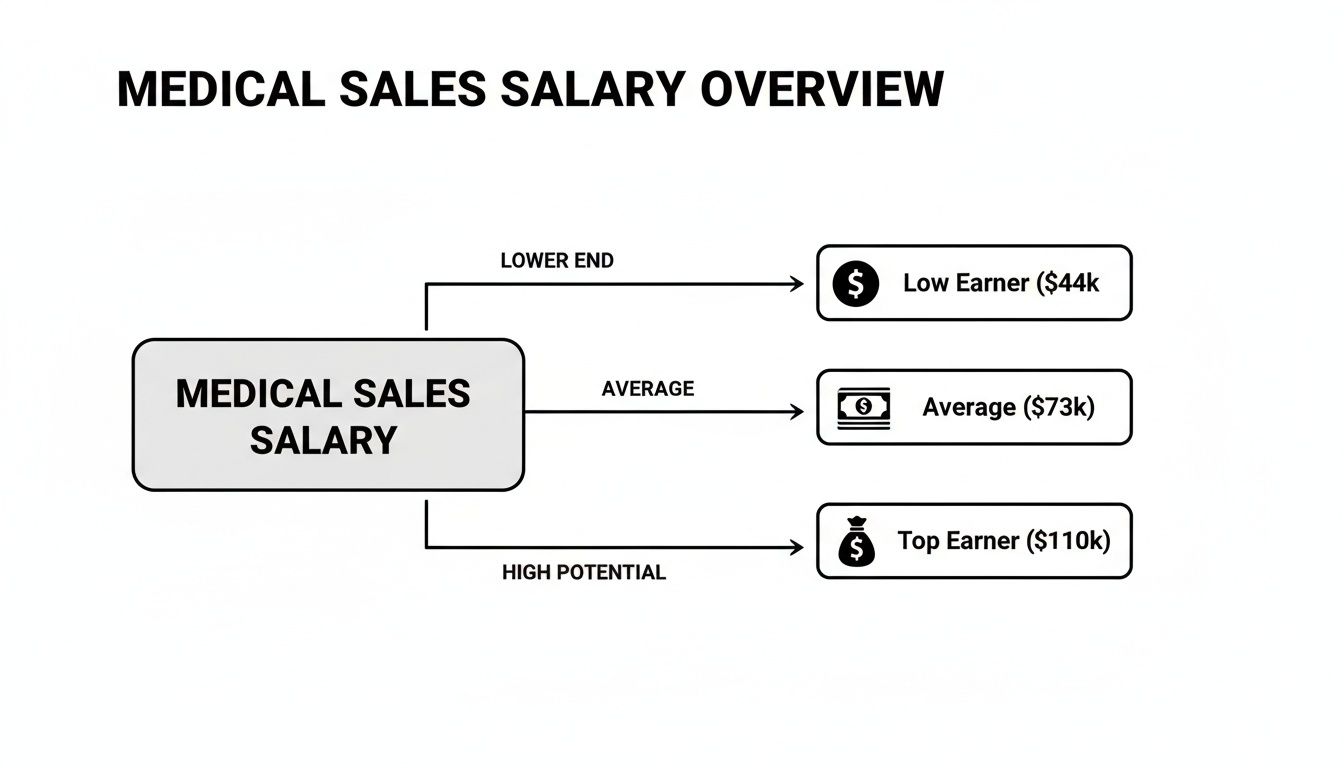
As you can see, what separates the average earners from the top-tier pros is almost always a massive performance-based commission check.
Common Commission and Bonus Structures
Now, "variable pay" isn't just one thing; companies structure it in a few different ways. Knowing how these work is crucial to figuring out how, and how much, you'll get paid for your results.
A common compensation plan in medical sales is a 60/40 or 70/30 split. This means 60-70% of your OTE is your base salary, and the other 30-40% is variable. In really competitive fields, like surgical device sales, you might even see a 50/50 split, which signals a higher-risk but much higher-reward role.
Here are a few of the commission models you're most likely to run into:
Tiered Commissions: This is a very common and motivating model. Your commission rate actually increases as you sell more. For example, you might earn 5% on the first $500,000 you sell, but the rate jumps to 7% for every dollar you sell after that. It's designed to powerfully reward over-performance.
Commission with Accelerators: Accelerators are rocket fuel for your commissions. They typically kick in after you’ve hit 100% of your quota. So, once you hit your goal, every sale you make might be paid out at 1.5x or even 2x your normal commission rate. This is how the top reps post truly staggering income numbers.
Management by Objectives (MBOs): Sometimes, part of your bonus isn't tied to a hard sales number but to other strategic goals. These are called MBOs, and they could include tasks like successfully launching a new device in your territory, landing a major contract with a key hospital system, or gaining market share from a top competitor.
When you're looking at a job offer, don't stop at the base salary or even the OTE. You have to dig deeper into the commission plan. Is there a cap on what you can earn? How attainable is the quota? The fine print will tell you everything you need to know about the role's true upside and your potential average medical sales salary.
Not All Medical Sales Roles Are Created Equal

The title "medical sales rep" is a massive umbrella. It covers roles so different they might as well be in separate industries, and that's especially true when it comes to pay. The average medical sales salary can swing wildly depending on whether you’re selling a well-known prescription drug or a complex surgical robot.
Why the huge difference? It all comes down to the value and complexity of what you're selling. Think of a pharma rep calling on a dozen primary care offices a day—their job is about frequency, education, and keeping their drug top of mind. Now, picture a surgical device rep scrubbed into an operating room, guiding a surgeon through a delicate procedure. The level of risk, clinical knowledge, and direct impact on patient outcomes is worlds apart, and the compensation structure reflects that reality.
Pharmaceutical Sales Representative
For many, pharma sales is the classic entry point into the medical industry. As a pharmaceutical rep, your day-to-day involves visiting physicians in their offices, educating them about your company's drugs, leaving samples, and building the relationships that encourage them to write prescriptions.
The sales cycle tends to be quicker, and success is often a numbers game—building a wide network across a large territory. Because the products are typically less complex and the setting is less intense than a hospital or OR, the pay, while very respectable, usually sits on the lower end of the medical sales ladder.
According to in-depth research on pharmaceutical sales salaries, the average total compensation for a pharmaceutical sales role is about $140,584. This is typically a mix of a strong base salary and a bonus tied to how many prescriptions are written in your territory.
Medical Device and Surgical Sales Representative
This is where you see a real jump in both responsibility and earning potential. These reps sell the actual tools of medicine—things like orthopedic implants, cardiac stents, or large-scale diagnostic imaging machines.
The job changes completely. You’re moving out of the clinic and into the hospital, often right into the operating room. To succeed here, you need a deep well of clinical and technical knowledge because surgeons will lean on your expertise during live procedures.
Marathon Sales Cycles: You don't sell a $500,000 MRI machine in one meeting. It’s a long game of strategic conversations with surgeons, department heads, and hospital administrators that can take months, or even years.
High-Stakes Environment: These products are often essential to a successful surgery and a patient's quality of life. The pressure is immense, but so are the rewards.
You're the Expert: You must be able to talk shop with surgeons, understand complex anatomy, and confidently guide them on how to use your device under pressure.
This elevated role comes with elevated pay. Commission plans are usually much more aggressive because a single sale can bring in massive revenue. MedReps reports put the average total compensation for medical device sales at $155,605, but that’s just the average. Top reps in hot specialties like cardiology or spine can earn far more. If this path interests you, it's worth digging into what medical device reps make to see what drives those higher salaries.
Specialized Biotech and Capital Equipment Roles
At the very top of the pay scale, you'll find the most specialized roles in the industry. These reps are selling revolutionary biotech therapies or multi-million-dollar surgical robotics systems. The sales process is incredibly complex and strategic, often involving long-term partnerships negotiated with C-suite executives.
These positions demand the best of the best—a combination of elite sales talent, deep clinical fluency, and sharp business acumen. The base salaries are higher, to begin with, and uncapped commission plans mean top performers can easily clear $250,000 or $300,000 a year. The average salary for biotech sales, for example, is around $160,951, but the ceiling is virtually nonexistent for those who excel.
Ultimately, your choice of specialty is one of the biggest factors in your career trajectory. While a pharma career is stable and financially rewarding, moving into a more specialized field like medical devices or biotech is the most direct route to a higher average medical sales salary and a significantly greater lifetime earning potential.
How Experience and Specialty Boost Your Earnings
In medical sales, your starting salary is exactly what it sounds like: a starting point. The real story of your earning potential is written over time, and it's driven by two key factors—your experience in the field and the specialty you choose to master.
Think of it like this: an entry-level rep is just learning the ropes. They're building their network, getting to know the product inside and out, and earning the trust of clinicians. But as you gain years of experience, your value skyrockets. A seasoned pro with a decade under their belt isn't just selling a device; they're a trusted consultant in the operating room or clinic. That expertise is what commands a higher paycheck.
The Career Ladder of Compensation
Your financial journey in this industry follows a pretty clear upward trend. With each step up the ladder, you don't just see a bigger base salary. More importantly, your On-Target Earnings (OTE) grow substantially as you prove you can consistently hit and crush your sales goals.
Here’s what that progression generally looks like:
Entry-Level (0-2 Years): When you're just starting, you're focused on learning. The average total compensation is around $98,000, with a bigger portion coming from your base salary while you build up your territory.
Mid-Career (3-9 Years): Once you have a proven track record, your variable pay (commission and bonuses) becomes a much more significant part of your income. You’ve built solid relationships and understand your market, pushing your OTE well into the six-figure range.
Senior-Level (10+ Years): At this point, you're an expert. Your deep network and clinical knowledge are invaluable. It’s no surprise that reps with over a decade of experience see their average total compensation jump to $208,498 and often much higher.
As you gain this experience, the financial trajectory is clear. You shift from learning the job to mastering it, and your paycheck reflects that mastery. The biggest leaps in average medical sales salary happen when a rep proves they can deliver results year after year.
The Power of Specialization
While experience builds a strong foundation, specializing is what truly unlocks the top-tier earning potential. Let’s be clear: not all medical sales fields are paid the same. The more complex the product and the more critical its role in patient outcomes, the higher the compensation.
This is where you can be strategic with your career path. Some of the highest-paying specialties include:
Cardiology: Selling pacemakers, stents, and other life-saving cardiac devices demands deep technical knowledge and the ability to stay cool under pressure in the cath lab. The high-stakes nature of these products commands premium pay.
Orthopedics & Spine: Reps in this space are often right there in the operating room, helping surgeons with complex joint replacements and spinal fusions. Their expertise is mission-critical, and their pay shows it, with top earners pulling in over $270,000.
Oncology & Biotech: This field involves selling sophisticated cancer treatments and biologic drugs. The science is intense, the sales cycles are long, and the products carry a high price tag—all leading to some of the biggest OTEs in the business.
Diving into a specialty is a real commitment. For instance, selling to hospitals means navigating a maze of administrative hurdles that are completely different from selling to a small private practice.
The industry also keeps growing. For example, recent data shows the average salary for pharmaceutical sales reps is $75,028, with projected increases on the horizon. This steady expansion highlights the stability and opportunity waiting in all kinds of different specialties.
Top Paying Cities for Medical Sales Professionals
When it comes to your paycheck in medical sales, the old real estate saying "location, location, location" is spot on. The average medical sales salary you see quoted online is just a baseline—where you actually live and work can swing your income by tens of thousands of dollars. Landing a role in a major city isn't just a change of scenery; it's a strategic career move.
These salary hotspots aren't random. They're driven by a dense ecosystem of world-class hospitals, leading research universities, and a high concentration of life sciences companies. We're not just talking about big cities; we're talking about the epicenters of medical innovation and healthcare spending.
Why Do Some Cities Pay More?
It really boils down to two things: a massive concentration of opportunity and a much higher cost of living. A city like Boston or San Jose is packed with high-value accounts, from major academic medical centers to the latest biotech startups. To land the talent needed to manage these complex relationships, companies have to bring their best offers to the table.
And of course, there's the simple reality of paying the bills. A salary that feels like a windfall in a smaller town might barely cover rent and expenses in a major metro. Employers know this, so they adjust their compensation plans to make sure they're offering a competitive and livable wage.
The numbers are pretty staggering. The national average base salary for a medical sales rep is about $93,369, but in a hub like San Jose, that figure can shoot up to an On-Target Earnings (OTE) of $184,346. That’s a 97% jump from the national average. This kind of geographic difference, which we also see in research on pharmaceutical sales salaries, creates huge opportunities.
This is a critical piece of the puzzle for both reps and hiring managers. If you're a rep, a strategic move could be the fastest way to hit your income goals. If you're building a team, you absolutely have to offer regionally-adjusted salaries to attract and keep top performers.
Comparing Top Paying Metro Areas
Let’s look at the hard numbers. Seeing the compensation data side-by-side really drives home just how much your territory can impact your wallet. You can use this as a benchmark for negotiating a new role or mapping out a potential relocation.
The table below breaks down the average total compensation in key markets. It clearly shows the premium that companies are willing to pay for talent in these major life sciences hubs.
Metro Area | Average Total Compensation (OTE) | Percentage Above National Average | Key Drivers |
|---|---|---|---|
San Jose, CA | ~$184,000 | ~97% | Silicon Valley tech synergy, high cost of living |
San Francisco, CA | ~$175,000 | ~87% | Dense concentration of biotech and pharma HQs |
Boston, MA | ~$168,000 | ~80% | World-renowned academic medical centers |
New York, NY | ~$165,000 | ~77% | Major financial and healthcare market |
Washington, D.C. | ~$160,000 | ~71% | Proximity to federal health agencies, NIH |
National Average | ~$93,369 | 0% | Benchmark for comparison |
The data tells a clear story: your zip code is one of the most powerful factors influencing your average medical sales salary. Moving from a mid-size market to a top-tier one could realistically double your long-term earning potential, especially once you factor in aggressive commission plans tied to larger, more lucrative accounts.
Using Data to Exceed Your Sales Quota and Salary

The highest-paid reps in medical sales aren't just working harder; they're working smarter. They’ve figured out how to turn an ocean of information into a treasure map, and that map leads directly to a higher commission and a bigger average medical sales salary.
Think about it. What if you knew exactly which surgeons in your territory had the highest procedure volumes for your specific device before you even picked up the phone? That’s not a lucky guess—it’s a powerful strategic edge that comes from using modern healthcare data platforms.
By moving beyond gut feelings and old call lists, you can focus your valuable time where it counts most: on the opportunities with the highest potential.
Pinpointing Your Best Opportunities
The whole idea is to stop casting a wide, inefficient net and start fishing with a spear. A robust healthcare data platform like G LNK gives you that spear by sifting through billions of medical claims and procedure records in an instant.
Instead of blanketing your entire territory with calls, you can build a qualified list of physicians and surgeons who are the most likely to adopt your product. This lets you walk into every meeting armed with real knowledge about a doctor's prescribing habits, their professional network, and the hospitals they work with.
The goal is to evolve from simply selling to becoming a strategic partner. When you approach a physician with insights relevant to their practice—like trends in local care delivery or how your product aligns with their specific patient population—you build credibility and open doors that remain closed to others.
This kind of precise targeting is the absolute foundation for blowing past your sales quota. To get a better handle on what "good" looks like, it’s worth exploring how to establish meaningful benchmarks in healthcare for your team.
Turning Data Into Higher Commission
Once you’ve identified your high-value physicians, the data then helps you craft a pitch they’ll actually want to hear. Healthcare commercial intelligence provides the context you need to make every single conversation count.
Here’s a practical, real-world example:
Identify a Target: Using a data platform, you discover a surgeon who performs a high volume of procedures where your new orthopedic implant is a perfect fit.
Gather Intelligence: The platform shows you she works at two different hospitals, but one of them is locked in with a competitor. You also find she’s published research on a specific surgical technique related to your product.
Tailor Your Approach: Now you can build your outreach around her expertise. You can highlight how your device improves outcomes for that exact technique and even bring data on cost-effectiveness to help her make the case to hospital administrators.
This level of preparation transforms a cold call into a valuable consultation. Of course, having the right data is only half the battle. A strong operational backbone is crucial for making this work across a whole team, and implementing Sales Operations Best Practices to Boost Revenue ensures everyone can turn these insights into income.
When you make data a core part of your daily workflow, you build a repeatable system for success. This isn't just about hitting your quota anymore. It’s about creating a machine to consistently demolish it, which is the most reliable way to maximize your commission and dramatically boost your average medical sales salary.
Answering Your Top Salary Questions
Let's cut through the noise. When it comes to compensation in medical sales, there's a lot of talk but not always a lot of straight answers. We've tackled the questions we hear most often from reps, both new and experienced, to give you the real-world breakdown.
How Much of My Pay Should Be Commission?
Think of your compensation as a balancing act between security and opportunity. The most common structures you'll see are a 60/40 or 70/30 split. This means 60-70% of your On-Target Earnings (OTE) is your guaranteed base salary, with the remaining 30-40% tied directly to your performance as commission.
However, in really competitive, high-stakes fields like surgical device sales, it's not unusual to see a 50/50 split. This structure carries more risk, but it also offers a much higher reward for top performers. The pay split really tells you a story about the company's culture and how much they're willing to bet on their sales team.
What Other Benefits Should I Expect?
The offer letter is just the beginning. A strong medical sales package goes far beyond your base and commission, and these perks add up fast.
It’s standard practice to receive a package that covers your tools of the trade. This almost always includes:
A company car or a monthly car allowance
A gas card and corporate credit card for travel and client expenses
A full tech setup, like a new laptop and smartphone
On top of that, you should expect premium health insurance, a solid 401(k) plan with a company match, and sometimes even stock options. Don’t underestimate these benefits; they can easily add tens of thousands of dollars to your total annual compensation.
The Bottom Line: Your total compensation is so much more than just your salary. When you factor in the car, insurance, and retirement benefits, the true value of an offer can be significantly higher than the number on the page.
Can I Actually Negotiate My Salary?
Absolutely. In this industry, negotiation isn't just possible—it's expected. But you can't walk in empty-handed. Success here comes down to preparation and data.
Use the salary benchmarks in this guide to ground your request in market reality for your specific role, experience, and location. Then, build your case by highlighting your wins: your sales numbers, specialized clinical expertise, or the surgeon relationships you've already built. Frame the conversation around the unique value you deliver, not just the number you want. And remember to negotiate the entire package, from base and commission to a potential sign-on bonus.
How Long Does It Take to Earn Six Figures?
For a motivated rep, breaking the six-figure barrier is a very achievable milestone, often happening within your first 3-5 years. While entry-level positions might start below that, your income potential climbs quickly once you prove you can hit and exceed your quota.
You can definitely speed up that timeline by targeting high-growth, high-demand specialties like medical devices, surgical, or biotech from the start. In medical sales, your drive, performance, and willingness to learn are directly tied to your paycheck.
Ready to arm your team with the intelligence needed to exceed sales quotas and make informed decisions? G LNK provides a single source of truth for clinician, institution, and market data. Explore our platform and start building a smarter commercial strategy today.
People also read

Mastering selling to hospitals: A 2026 Playbook for MedTech
Mar 11, 2026

Referring physician meaning: A Clear Guide to Your Care
Mar 14, 2026

How Much Do Medical Device Reps Make in 2026?
Mar 12, 2026

What Is Medical Affairs and Why Does It Matters in Pharma
Mar 16, 2026

Unlock benchmarks in healthcare: A data-driven strategy guide
Mar 13, 2026