Nov 13, 2025
Unlock benchmarks in healthcare: A data-driven strategy guide
Learn benchmarks in healthcare to sharpen market sizing, KOL engagement, and competitive advantage with actionable steps.
Navigating the healthcare market without benchmarks is like trying to drive across the country without a map, a speedometer, or even road signs. You might be moving, but you have no idea if you're heading in the right direction, how fast you're going, or where you stand relative to everyone else.
Benchmarks are that essential navigation system for pharma and medtech commercial teams. They provide a vital frame of reference—a "you are here" pin on the map—that turns a sea of raw data into a clear, strategic path forward.
Simply put, they are standardized metrics used to compare performance. That comparison might be against your own past results, a direct competitor's market share, or the industry-wide average. It's this context that helps you pinpoint your true market position, spot untapped opportunities, and avoid costly missteps.
From Guesswork to Grounded Strategy
For any leader in the life sciences, getting a firm grip on these metrics isn't just a good idea—it's essential for survival. Benchmarks are the foundation that allows you to answer the big, strategic questions that really drive the business forward.
Market Standing: How do we really stack up against our main competitor in this therapeutic area?
Sales Performance: Is our top territory actually outperforming, or is it just a high-volume market?
Opportunity Sizing: Which specific hospitals and health systems have the patient and procedure volumes to justify our focus?
Compliance & Payments: Are our honoraria payments for Key Opinion Leaders (KOLs) in line with Fair Market Value (FMV), or are we exposing ourselves to risk?
Without this comparative insight, you’re essentially making decisions in the dark, relying more on gut feelings and anecdotal evidence than on solid ground.
Benchmarking is what moves a team from asking, "What happened last quarter?" to "Why did it happen, and how can we make sure it goes our way next quarter?" It’s the critical shift from reactive reporting to proactive, intelligent strategy.
More Than Just Performance Numbers
Good benchmarks also shed light on bigger-picture dynamics, like regional economic pressures or even executive sentiment, which can be a leading indicator of market shifts.
For instance, a recent Deloitte survey of 180 C-suite executives found a fascinating split in confidence: while around 70% of non-US leaders felt optimistic about revenue growth, their American counterparts were far more cautious. In fact, 20% of US execs predicted a negative outlook, largely due to drug pricing pressures. This kind of benchmark is invaluable for tailoring your value proposition to address specific regional anxieties. You can explore more of these trends in the 2026 global health care outlook from Deloitte.
It's also important to remember that not all benchmarks are about sales or clinical outcomes. Compliance benchmarks, such as understanding the differences between SOC 2 and HITRUST, are just as critical for ensuring your data practices are secure and responsible.
Ultimately, using benchmarks in healthcare allows commercial teams to make smarter, evidence-backed decisions across the board—from redrawing sales territories to launching a new product with confidence.
The Four Types of Benchmarks That Drive Strategy
To get real value from benchmarks in healthcare, you have to know what you’re looking at. They aren't a one-size-fits-all tool. Think of it like a pilot in a cockpit; you wouldn't just rely on the altimeter. You need to see your speed, fuel level, and directional heading to get a complete picture. For commercial teams, each type of benchmark provides a different lens on the market, revealing specific opportunities and risks.
These data points generally fall into four critical categories. When you bring them all together, your view of the strategic landscape transforms from a flat, one-dimensional chart into a rich, multi-layered map.

1. Clinical Benchmarks
First up are clinical benchmarks, which get right to the heart of patient care. These metrics are all about quality and outcomes, answering the fundamental question: "How well is this hospital or clinic actually treating patients?" For pharma and medtech, these numbers are powerful clues that point to unmet needs where your product could make a real difference.
Practical Example: A pharmaceutical company develops a new drug shown to significantly reduce complications post-cardiac surgery. By benchmarking hospital readmission rates for bypass surgery patients, their commercial team can identify hospitals with rates higher than the national average. They can then approach these specific institutions with a targeted value proposition: "Our drug can help you lower your readmission rate, improve patient outcomes, and avoid CMS penalties."
Here are a few classic examples:
Hospital Readmission Rates: If a hospital has a high readmission rate for a condition your product addresses, that’s a huge opening. It’s a chance to show how you can improve long-term outcomes and save them money.
Hospital-Acquired Infection (HAI) Rates: For any company in the infection control space, this is a direct homing beacon. It points you straight to the accounts with the most urgent need for your solution.
Adherence to Clinical Guidelines: This shows you how consistently providers are following evidence-based protocols. Any deviation can reveal gaps in care or areas where your therapy offers a better path forward.
2. Operational Benchmarks
While clinical benchmarks measure the quality of care, operational benchmarks measure the efficiency of its delivery. They pull back the curtain on how smoothly a health system runs its daily business, exposing bottlenecks, resource gaps, and capacity limits. This is gold for commercial teams because it tells you what an institution is struggling with behind the scenes.
Operational data helps you understand the "how" behind the "what." A hospital might have high patient volumes (a clinical metric), but long procedure wait times (an operational metric) indicate a capacity issue your solution could help solve.
Practical Example: A medtech firm sells a surgical device that shaves 15 minutes off a standard orthopedic procedure. By benchmarking Average Length of Stay (ALOS) for joint replacement patients and procedure wait times, they can find hospitals struggling with operating room throughput. Their pitch then becomes highly practical: "We see your waitlist for knee replacements is 6 months long. Our device can help your surgeons perform two extra cases per day, increasing revenue and getting patients treated faster."
Sourced from hospital reporting and claims data, these metrics give you a feel for the pulse of the facility:
Average Length of Stay (ALOS): A long ALOS is a red flag for inefficiency and a major cost driver for hospitals. If your device or drug can help get patients home sooner, you’re aligning your value proposition directly with their financial and operational goals.
Procedure Wait Times: This is a straightforward indicator of patient access and departmental throughput. Long waits signal a facility that may be very open to hearing about efficiency-boosting technologies.
Emergency Department Throughput: A critical measure of a hospital's ability to manage patient flow under pressure, this benchmark can reveal systemic issues that ripple throughout the entire facility.
3. Financial Benchmarks
Financial benchmarks lay bare the economic realities of your target accounts. This is where we move beyond patient care and ask, "What is the business of healthcare like at this institution?" Getting a handle on this context is non-negotiable if you want to frame your product’s value in a way that resonates with the C-suite and economic buyers.
Practical Example: A company selling a premium-priced cancer therapy benchmarks the payer mix of different oncology centers. They discover one hospital has a high percentage of commercially insured patients, while a competitor across town primarily serves Medicare/Medicaid patients. They can then tailor their message: for the first hospital, they highlight superior efficacy and patient preference; for the second, they focus on long-term cost savings by reducing the need for subsequent treatments, aligning with the hospital's tight budget constraints.
By analyzing metrics like cost per procedure and payer demographics—often found in claims data and hospital cost reports—you can tailor your pitch with surgical precision.
4. Commercial Benchmarks
Finally, we have commercial benchmarks. These are the metrics that directly track what’s happening in the marketplace—your market share, your competitors’ footing, and the influence of key players. This is where you grade your own team’s performance against the reality on the ground.
These benchmarks are your eyes and ears in the field:
Prescribing and Procedure Volumes: Pulled from billions of claims records, this data shows exactly which providers are treating which patients and with what therapies. It’s the bedrock of any credible market share analysis.
Key Opinion Leader (KOL) Activity: By tracking payments through government databases like CMS Open Payments, you can identify the true influencers in a therapeutic area. This also helps ensure your own KOL engagement strategies meet Fair Market Value (FMV) standards. As your team grows, it's also worth exploring how medical device rep compensation structures are built, as pay is often tied directly to these performance metrics.
The real magic happens when you stop looking at these four benchmark types in isolation. By integrating them through a unified data source, your team can move from chasing disconnected data points to executing a cohesive, intelligent, and truly actionable strategy.
Putting Benchmarks to Work in Your Commercial Strategy
Alright, so we've covered what benchmarks are. But how do you actually use them? This is where the rubber meets the road—where we turn all that data into a real-world commercial playbook.
Using benchmarks in healthcare isn't about collecting metrics for the sake of it. It’s about knowing which questions to ask and where to find the answers that give you a competitive edge. From sizing up a new market to keeping your KOL engagements compliant, benchmarks are the engine behind a smart commercial plan.
Accurate Market Sizing and Territory Planning
Guessing your market size is a recipe for wasted resources and missed targets. One of the most direct ways to use benchmarks is to get a crystal-clear picture of your total addressable market. Procedure volume benchmarks are perfect for this, cutting right through the ambiguity.
Let’s say you’re launching a new device for knee replacements. Instead of just looking at population maps, you can use procedure claims data to see exactly which hospitals and ambulatory surgery centers (ASCs) are doing the most knee surgeries. Suddenly, you're not just guessing—you have a data-backed map of genuine, proven demand.
This kind of detail is becoming absolutely essential. We're seeing a huge market shift toward outpatient services, driven by value-based care and our aging population. According to EY, these ambulatory and post-acute segments are set to lead healthcare growth. By digging into over 5 billion procedure records, medtech teams can spot the high-growth ASCs and focus on the physicians driving that volume, aligning their strategy with where the market is headed. You can explore the full healthcare sector outlook on EY.com.
Practical Example: A medtech company was targeting a major city hospital based on its reputation, but procedure volume benchmarks told a different story. They discovered that three smaller ambulatory surgery centers in a neighboring suburban area were performing 40% more relevant procedures combined. They reallocated two sales reps from the city to this suburban cluster and saw a 25% increase in qualified leads within a single quarter.
This data-driven approach completely changes how you build sales territories. Forget about just drawing lines based on zip codes. You can now create balanced territories based on actual, quantifiable opportunity, giving every rep a fair chance to succeed.
Identifying Key Opinion Leaders and Ensuring FMV Compliance
Finding a true Key Opinion Leader (KOL) is about more than just a fancy title at a well-known hospital. Real influence is something you can measure. By benchmarking publication histories, clinical trial participation, and speaking engagements, you can find the healthcare professionals (HCPs) who are actually shaping the conversation in their field.
This is where combining different data sources really pays off:
Publication Data: Who is publishing the research that informs evidence-based medicine?
Clinical Trial Data: Who are the investigators leading the charge on innovation in your therapeutic area?
Payments Data: Using sources like the CMS Open Payments database, you can see which HCPs your competitors are already paying for consulting and speaking gigs.
This approach doesn't just help you find the right partners; it keeps you compliant. Fair Market Value (FMV) benchmarks create a defensible standard for what you pay physicians for their time. Instead of pulling a number out of thin air, you can base your honoraria on what’s standard for an HCP with a similar specialty, experience level, and geographic location, which is critical for mitigating risk.
Competitive Intelligence and Performance Tracking
You can’t win if you don't know the score. Benchmarking your market share against competitors is non-negotiable. With prescribing and procedure data, you can see—almost in real time—how your product is stacking up against others, all the way down to a specific hospital or even a single doctor.
The screenshot below from a platform like G LNK shows how this competitive view comes to life, mapping out HCPs and the facilities they work with.
A visualization like this gives your commercial team an instant roadmap. You can spot the key accounts and understand the web of influence in a region, helping reps know exactly who to talk to.
This kind of intelligence allows you to be proactive instead of reactive. See a competitor gaining ground in one of your key territories? You can immediately dig in to find out why. Is it their pricing? A new message that’s resonating? This insight lets you respond quickly to defend your position. For a closer look at what it takes to break into these large, complex accounts, you can learn more about the complexities of selling to hospitals.
By putting these practices to work, commercial teams can shift from simply reacting to market changes to driving them. The right platform can turn these once-manual, time-consuming tasks into a fluid workflow, transforming billions of data points into your next winning strategy.
How to Avoid Common Healthcare Benchmarking Pitfalls
While using benchmarks in healthcare can be incredibly powerful, a flawed approach is often worse than using no benchmarks at all. When multi-million dollar decisions hang in the balance, getting this right is non-negotiable. Bad data can send your entire commercial strategy spiraling in the wrong direction.
Let's walk through the common traps that even the most well-intentioned teams fall into. Recognizing these pitfalls is the first step to building a resilient, data-informed strategy that actually works.
The Danger of Outdated or Incomplete Data
One of the most common and costly mistakes is working with stale information. The healthcare market moves incredibly fast. A report from six months ago might as well be from another era. If you're aligning territories or sizing a market based on last year's procedure volumes, you’re already behind, likely missing the very accounts that are showing the most growth.
Incomplete data is just as dangerous. It gives you a warped view of reality. For example, if your analysis only covers hospital data, you’re completely blind to the booming ambulatory surgery center (ASC) market. You're ignoring a massive and growing piece of your potential audience.
Practical Example: A device company plans a product launch based on prescribing data from a year ago. They are unaware that a key competitor launched a new-generation device six months prior, and prescribing habits have already shifted dramatically. Their launch forecast is off by 30%, and the sales team walks into conversations that are already out of date.
The Classic Mistake of Comparing Apples to Oranges
The entire point of benchmarking is to make meaningful comparisons. But this only works if you’re comparing like with like.
Pitting a major urban academic medical center against a small rural community hospital is a classic "apples to oranges" error. Their patient populations, case mix severity, and available resources are worlds apart. Any insights you draw from that comparison will be fundamentally flawed.
To get this right, you have to apply data normalization. This just means adjusting the data to account for variables that would otherwise skew the results. Critical factors include:
Case Mix Index (CMI): This reflects the complexity of a hospital's patients. A higher CMI means sicker patients, which naturally leads to higher costs and longer stays.
Geographic Location: Costs, payer mix, and patient demographics can vary dramatically between an affluent suburb and an underserved urban area.
Facility Type: You can't directly compare a specialty orthopedic hospital to a general acute care facility and expect to get a clear picture.
Proper normalization is what makes your comparisons fair, accurate, and truly strategic. It’s an essential step for building reliable benchmarks in healthcare.
Chasing Vanity Metrics Instead of Business Outcomes
The final major pitfall is getting distracted by "vanity metrics." These are numbers that look great on a dashboard but have zero connection to your actual business goals.
For instance, celebrating a huge spike in website visits from physicians is pointless if none of them are in your target specialty or ever become a qualified lead. The metric looks good, but it doesn't move the needle.
To sidestep this trap, every Key Performance Indicator (KPI) you track must be directly tied to a specific commercial objective. Start with the goal—like "Increase market share by 5% in the Midwest"—and then work backward. Identify the metrics that truly measure progress, such as procedure volume growth at target accounts or competitor displacement rates. This keeps your team focused on what really matters: driving measurable results.
Navigating these challenges is critical for success. The table below summarizes these common mistakes and provides clear, strategic solutions to keep your benchmarking efforts on track.
Benchmarking Pitfalls and How to Solve Them
Common Pitfall | Why It's a Problem | Strategic Solution |
|---|---|---|
Outdated or Incomplete Data | Decisions are based on a reality that no longer exists, leading to missed opportunities and wasted resources. | Prioritize data sources that offer near real-time updates. Ensure your data platform integrates information from all relevant care settings (hospitals, ASCs, clinics). |
Comparing Apples to Oranges | Insights are skewed and misleading, resulting in poor strategy and unfair performance evaluations. | Apply rigorous data normalization. Adjust for variables like Case Mix Index (CMI), geography, facility size, and teaching status to create a level playing field. |
Chasing Vanity Metrics | The team focuses on metrics that feel good but don't drive actual business growth, leading to a false sense of progress. | Define clear business objectives first. Work backward to identify KPIs that directly measure progress toward those specific goals (e.g., market share, procedure growth). |
Ignoring Qualitative Context | Numbers alone don't tell the whole story. A hospital's low performance might be due to a recent merger or a new EMR system, not poor management. | Supplement quantitative data with qualitative insights. Talk to field teams, read local news, and understand the "why" behind the numbers before jumping to conclusions. |
By proactively addressing these potential issues, you can transform benchmarking from a risky exercise into one of your most valuable strategic tools, ensuring your commercial decisions are built on a foundation of solid, reliable data.
A Practical Guide to Implementing Your Benchmarking Strategy
Knowing what benchmarks are is one thing; putting them to work is another. A successful benchmarking program isn't built overnight—it's the result of a deliberate, step-by-step process. Think of this as a practical playbook for turning raw data into a real commercial advantage.
1. Define Your Commercial Objective First
Before you even look at a data point, you must know what you’re trying to achieve. Simply wanting "more data" is a recipe for getting lost. Your objective must be concrete, measurable, and directly tied to a commercial outcome.
Practical Example: Don't start with a vague goal like, "We want to grow our business." A much stronger starting point is, "We need to increase market share for Product X by 10% in the Northeast by targeting high-volume ambulatory surgery centers within the next six months." This clear goal becomes the compass for every subsequent step.
2. Focus on the KPIs That Actually Matter
Once you have a clear objective, you can pick the Key Performance Indicators (KPIs) that will actually tell you if you're on track. If your goal is to grow market share, you can't just look at your own sales figures. You need to benchmark procedure volumes at target facilities, track competitor sales in the region, and identify influential prescribers you haven’t reached.
Pro Tip: One of the most common mistakes is getting buried in dozens of metrics. Stick to the vital few that are directly tied to your primary goal. If a metric doesn't help you measure progress towards your objective, it’s just noise.
3. Bring Your Data Together
You can't build an effective benchmark on a foundation of scattered information. You absolutely need a single source of truth that merges claims data, physician profiles, and facility-level intelligence. Juggling separate spreadsheets for prescribing habits, hospital affiliations, and KOL payments is not only inefficient—it creates massive blind spots.
To get the full picture, your data must be interconnected. This allows you to ask powerful, specific questions, like, "Which physicians at high-volume ambulatory surgery centers don’t use our product but are affiliated with our top-performing hospitals?" An integrated platform is what makes answering that question possible.
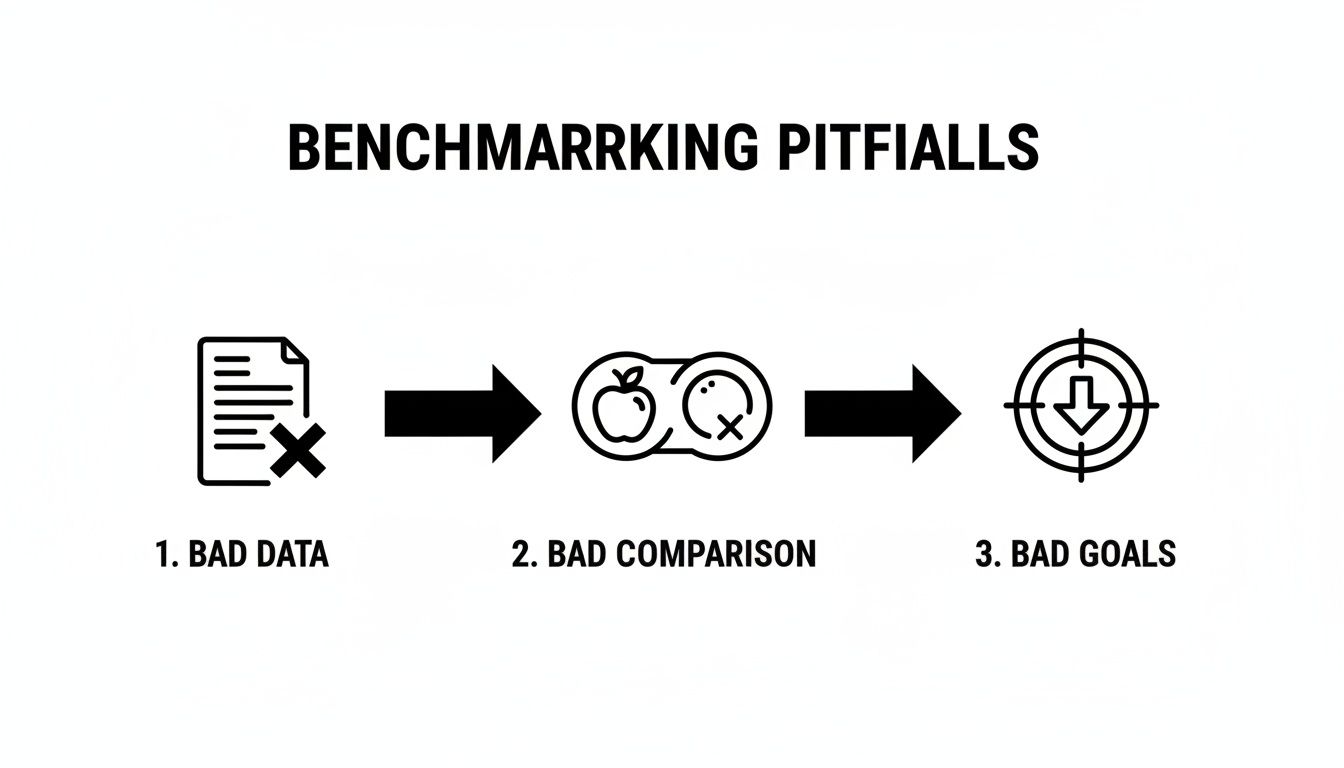
The lesson here is simple: if you start with bad data, you'll end up with flawed comparisons and, ultimately, a strategy built on shaky ground.
4. Find the Story in the Data
Raw numbers are just noise. The magic happens when you visualize that data and turn it into a story. Dashboards are perfect for tracking your chosen KPIs, spotting new trends, and flagging outliers that need a closer look.
Practical Example: A map visualizing procedure volumes might instantly reveal an untapped territory with high demand right next to one you thought was saturated. A simple line chart tracking a rival's market share could reveal a sudden dip, signaling a prime opportunity for your team to move in and capture that business.
5. Set Realistic, Data-Driven Targets
Your goals can't be based on wishful thinking. They need to be grounded in credible industry and competitor benchmarks in healthcare. If the top player in a market holds 15% share, setting a goal to hit 50% in a year is setting your team up for failure.
A much smarter approach? Aim to capture 5% from your closest competitor by identifying and targeting their most under-supported accounts. This is where external data, like the state-level health spending reports from the Peterson-Milbank Program, can provide invaluable context for setting realistic expectations.
6. Put Your Insights into Action
This is where the rubber meets the road. All the analysis in the world is useless if it doesn't lead to action. The key is to operationalize your findings by weaving them directly into your team's day-to-day work.
For Sales Reps: Don't just give them a spreadsheet. Push an updated list of high-potential HCPs with recent, relevant procedure volumes directly into their CRM.
For Marketers: Use prescribing data to build smarter, highly targeted digital ad campaigns that reach the exact physician specialties and geographies you're focused on.
For Leadership: Set up automated weekly reports that track progress against your core KPIs so everyone knows the score and can course-correct quickly.
7. Make It a Cycle, Not a One-Off Project
Finally, benchmarking is not a "one and done" project—it’s a continuous loop. Markets change, competitors launch new products, and fresh opportunities appear out of nowhere. You need to establish a regular rhythm for reviewing your benchmarks, re-evaluating your goals, and tweaking your strategy. This ongoing commitment is what separates the teams that just report on what happened from those who actively shape what happens next.
The Future of Healthcare Benchmarking in 2026 and Beyond
If your commercial team is still making decisions based on last quarter’s data, you’re already falling behind. The days of static reports and historical analysis are numbered. We're rapidly moving toward a future defined by real-time data, predictive insights, and a much sharper focus on the patient's experience.
The quarterly performance review, once a cornerstone of commercial strategy, is being replaced by dynamic, live dashboards. Instead of dissecting what happened three months ago, leading teams are seeing market shifts as they unfold. This means spotting a competitor’s drop in market share or a surge in procedures at a key hospital the moment it happens, not long after the opportunity has passed.
From Historical Data to Predictive Insights
The biggest change coming to healthcare benchmarking is the shift from analyzing the past to predicting the future. This isn't science fiction; it's the practical application of artificial intelligence (AI) and machine learning (ML). For years, benchmarks told us what happened. Now, they’re starting to tell us what’s likely to happen next.
By sifting through billions of data points—like prescribing habits, claims data, and referral patterns—AI models can detect the faint signals that come before a major market event. This allows teams to anticipate changes in treatment protocols or a competitor’s next move, giving them a crucial head start. As you build out your own capabilities, it's worth exploring the different AI tools for KPI benchmarking that are becoming available.
The Rising Influence of Patient-Centric Benchmarks
At the same time, a new category of benchmarks is gaining serious traction: those centered on the patient. While clinical and financial metrics will always be important, the industry is finally waking up to the need to measure what matters most to the person receiving the treatment.
We're seeing a few key metrics take center stage:
Patient-Reported Outcomes (PROs): This is data coming directly from patients about their own health and quality of life, with no interpretation from a clinician.
Digital Engagement Data: These metrics show how patients are interacting with telehealth services, support programs, and digital health tools.
Adherence Metrics: This goes beyond simple prescription fills to track how consistently patients are sticking to their treatment plans.
This kind of data gives a far richer, more human picture of a therapy's true impact. For pharma and medtech companies, it’s a powerful way to demonstrate value that goes beyond a clinical trial endpoint.
A critical future benchmark will be the ability to connect a product not just to a clinical outcome, but to an improved patient journey. This is what payers, providers, and patients themselves are beginning to demand.
This forward-looking approach is becoming essential. For example, global healthcare costs are projected to jump by over 10% in 2026, and the U.S. alone is facing a 9.6% increase fueled by expensive specialty drugs. Find out more about these global healthcare cost projections. In this high-stakes environment, every decision counts. Platforms like G LNK can analyze over 3B+ prescribing records to identify the most relevant physicians in these high-cost markets, helping leaders align their teams with real-time trends to protect margins.
Ultimately, the future of benchmarks in healthcare isn't about collecting more data. It's about getting smarter, faster insights that empower commercial teams to act decisively and stay ahead of the curve.
Frequently Asked Questions About Healthcare Benchmarks
It's natural to have questions when you're getting started with a benchmarking strategy. Let's tackle some of the most common ones that come up so you can move forward with confidence.
Where Can We Get Reliable Data for Healthcare Benchmarks?
This is the million-dollar question. Good data often feels scattered to the winds, spread across medical and pharmacy claims, hospital performance reports, and government databases like CMS Open Payments. The real headache isn't a lack of data; it's that none of it talks to each other.
That’s where integrated data platforms really prove their worth. Instead of your team spending countless hours trying to manually stitch everything together—a process that’s both tedious and full of potential errors—these platforms do the heavy lifting. They bring billions of disconnected data points into one clean, searchable source of truth.
How Often Should My Team Review Our Benchmarks?
The answer really depends on what you're measuring. For fast-moving commercial metrics like market share or prescribing habits, you'll want to check in monthly or quarterly. The market waits for no one, and this cadence keeps you agile.
On the other hand, broader operational or financial benchmarks tied to institutions are typically updated quarterly or annually. The best approach is to use a platform with regularly refreshed data. This shifts your team from making decisions on static, outdated reports to acting on a near real-time pulse of the market.
A benchmark is only as good as its timeliness. An outdated metric can lead to a strategy that is already irrelevant by the time it's implemented.
What Is the Right First Step for Starting a Benchmarking Project?
Before you even think about the data, you need to define your goal. It's tempting to jump right into the numbers, but that's a recipe for getting lost. Start by asking a simple, direct question: "What problem are we trying to solve?" or "What specific outcome are we aiming for?"
Whether you're trying to find untapped markets, make your sales team more effective, or optimize your KOL engagement spend, a clear objective is your north star. It focuses your efforts and points you directly to the Key Performance Indicators (KPIs) that truly matter. If you want to dig deeper into building a solid strategy, feel free to find more guides on the G LNK blog.
Ready to turn data into a decisive commercial advantage? G LNK unifies data on 9.2M+ HCPs, 68K+ hospitals, and billions of claims records into a single source of truth. Find your market, identify key players, and build your next winning strategy with a platform designed for life sciences.